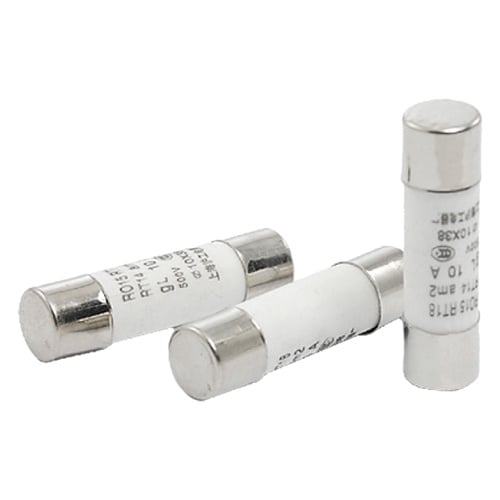
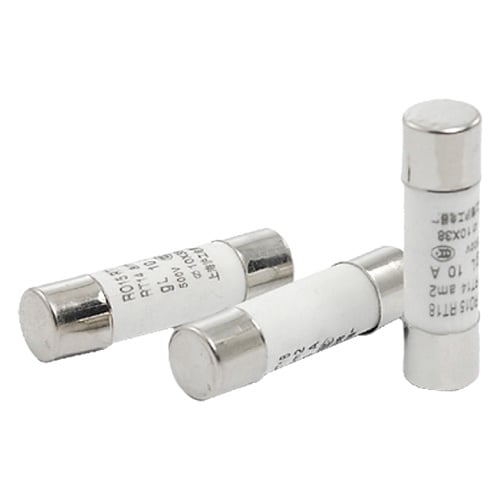
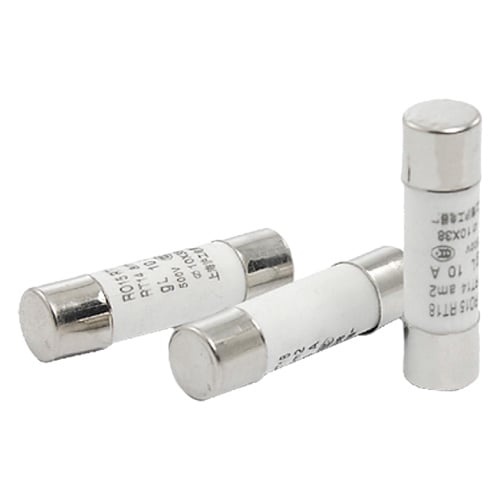
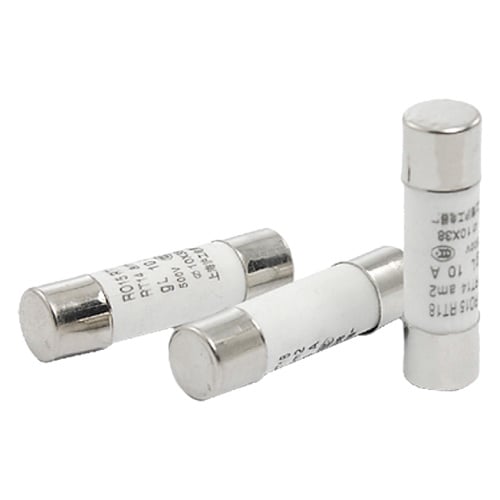
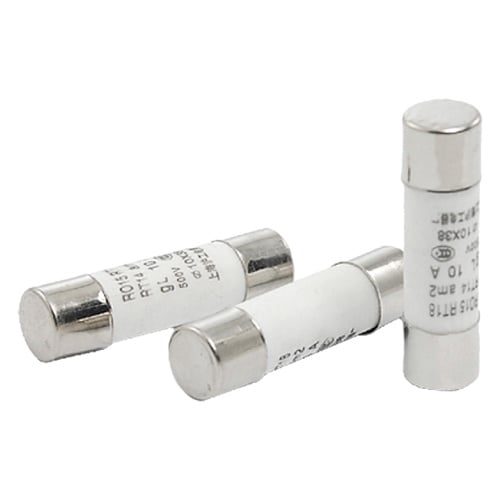
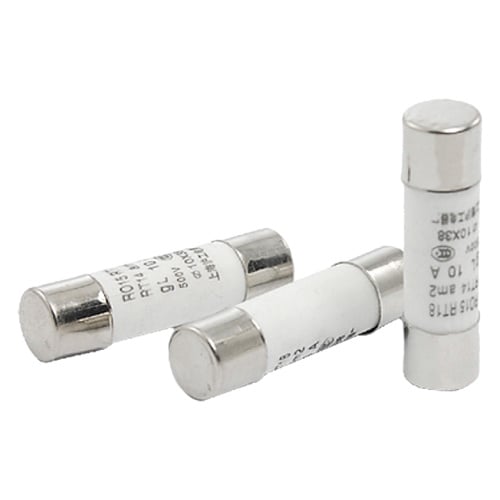
Class gPV 10×38 cylindrical fuses are the standard protection for solar panel strings. They are specifically designed for direct current at 1,000 V, which is what distinguishes a photovoltaic fuse from a conventional one.
When is a fuse required in each string?
When there is three or more strings in parallel. With one or two modules, if one fails, the reverse current generated by the others is not enough to damage it. With three or more, however, it is, and a fuse becomes compulsory.
What does the gPV class mean?
This is the service class defined for photovoltaic systems: g indicates that the fuse provides protection across the entire range, from minor overloads to short circuits, and PV that its curve matches the behaviour of a solar generator, which has a low, steady fault current rather than a sudden spike.
An industrial gG fuse trips too late at those currents, because it is designed for faults fed by the mains supply.
Can fuses be reused after they have been fired?
No. Even if the fuse appears undamaged on the outside, the internal element has deteriorated and its curve is no longer as it was originally: it may blow prematurely or, worse still, too late. They should always be replaced with one of the same rating and type.
Available from 10 A to 32 A, all rated at 1000 VDC. To calculate the wire size based on the module’s Isc, see fuses; you’ll also need the fuse holder relevant.