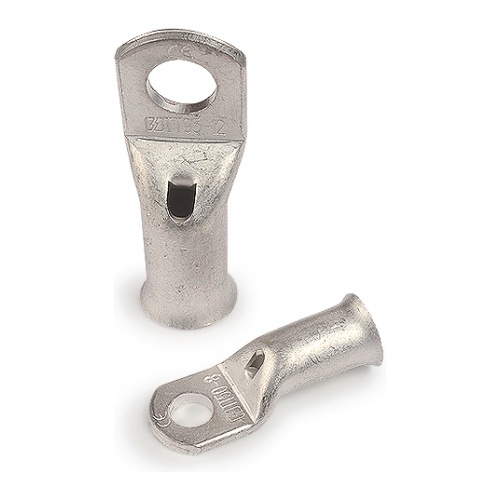
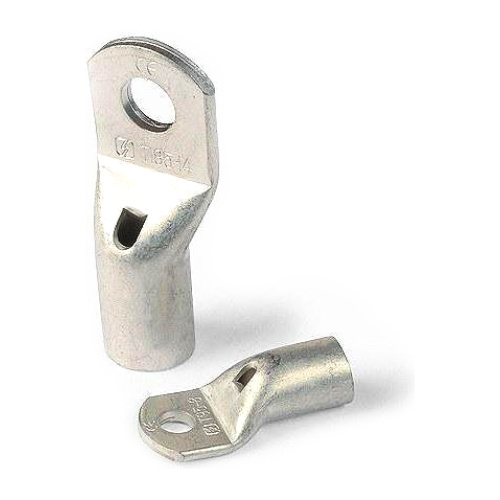
Screw terminals are the point where the cable becomes a connection. A correctly crimped connection has less resistance than the cable itself; a poorly crimped one is a hot spot that deteriorates with every cycle until it fails.
What terminal do I need for each section of cable?
The terminal must correspond to the actual cross-sectional area of the cable and to the bolt diameter where it is screwed in. Both specifications are included in the reference: a 50-10 terminal is for a 50 mm² cable and an M10 screw.
Using a terminal with a larger cross-section «just because it fits» leaves the cable loose inside the tube: the crimp does not compress properly, air pockets remain, and contact resistance skyrockets.
Can the terminals be crimped using pliers?
No. A power crimp requires uniform pressure across the entire surface, and only a hydraulic crimping tool or a die set with the correct profile can achieve this. Crimping with pliers deforms the tube on one side and leaves the other side uncompressed.
A good crimp can be recognised by the fact that the tube bears the mark of the die along its entire length and the cable does not move when pulled firmly.
Do you need to tin the wire before crimping it?
No, and it’s a common mistake inherited from electronics. Tin flows at low temperatures Under constant pressure: a joint that is tight today will loosen of its own accord in a few months’ time. In power connections, crimping is carried out on clean copper, without tin plating.
See also electric cable y fuses in our electrical equipment section.