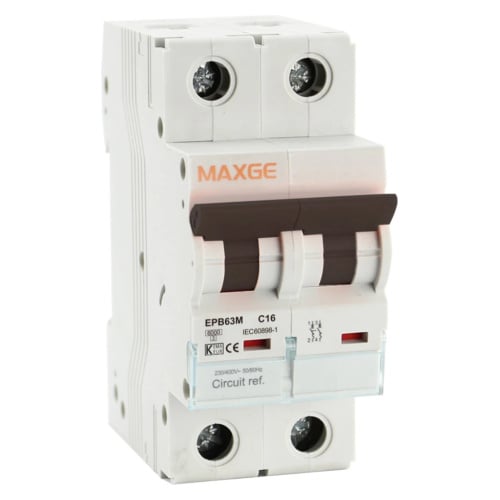
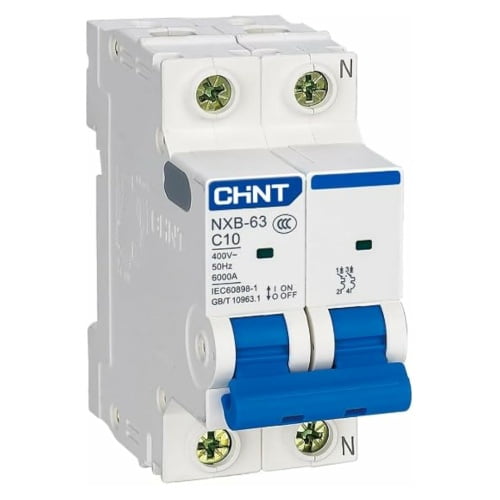
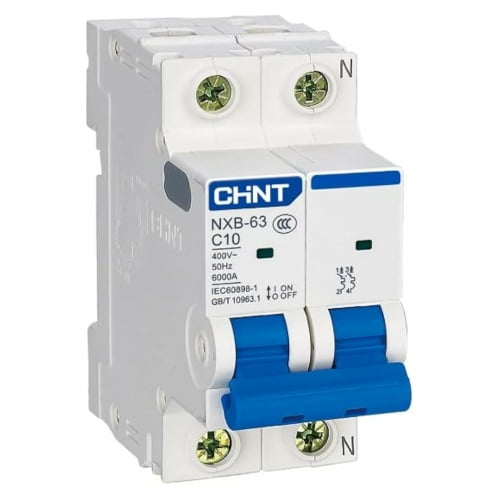
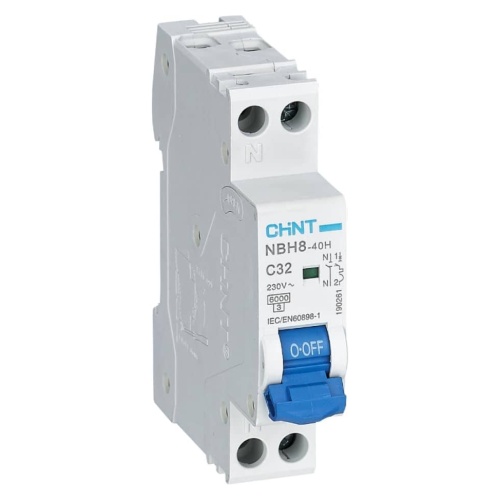
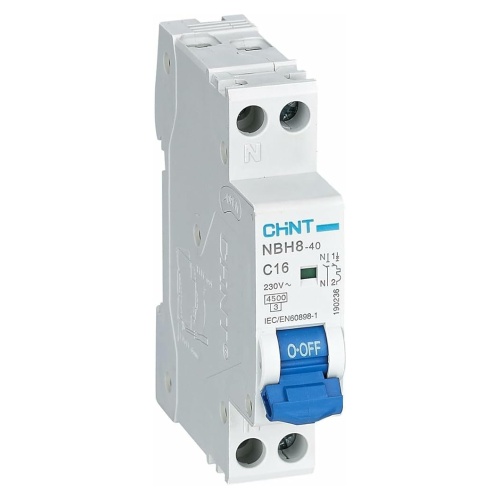
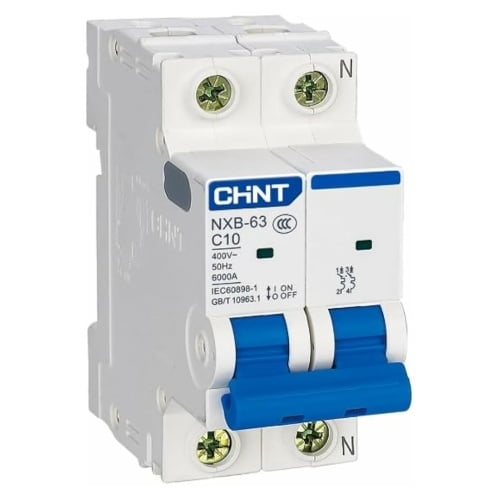
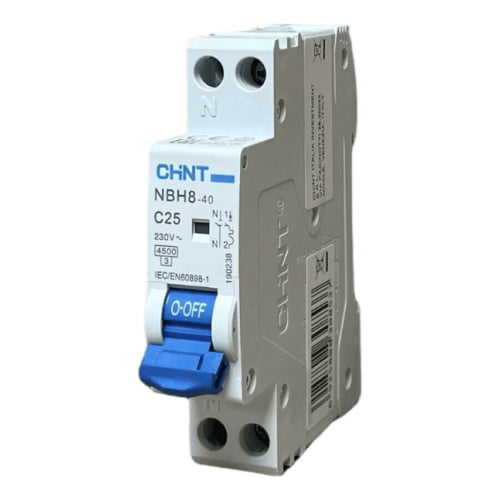
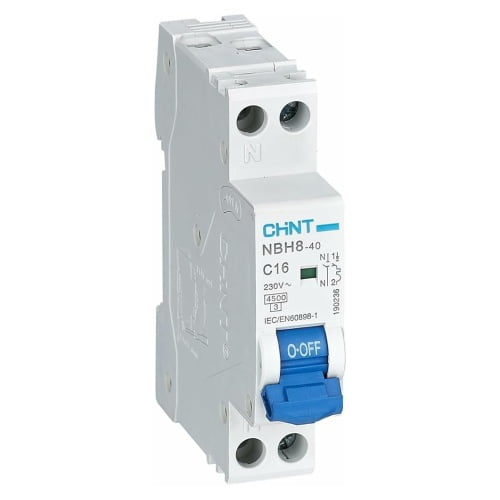
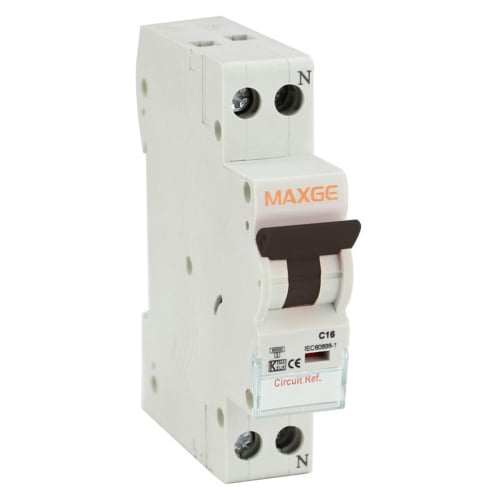
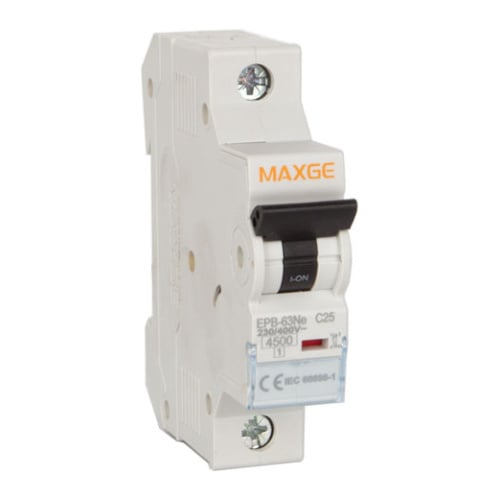
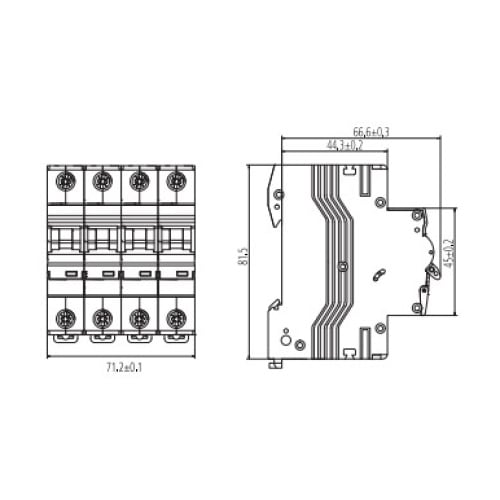
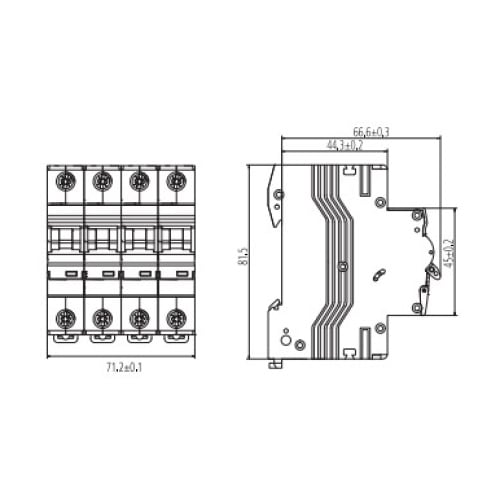
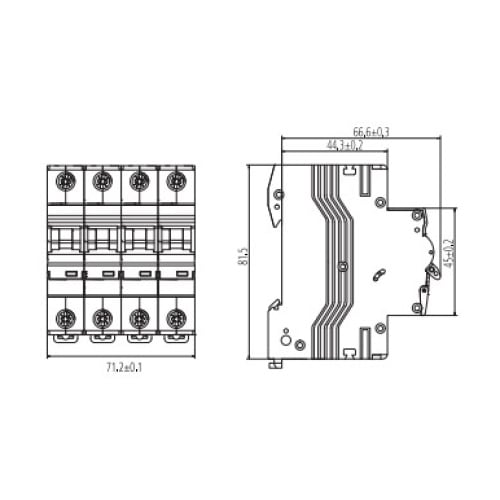
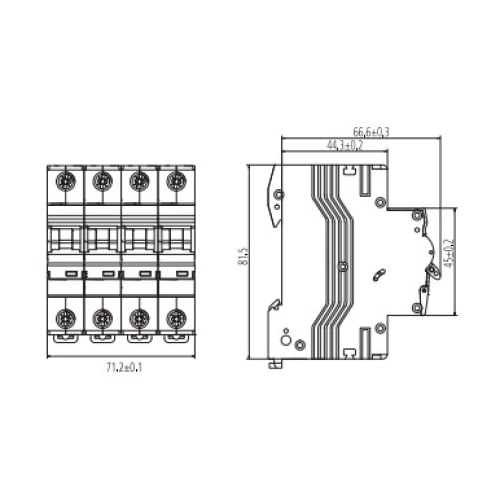
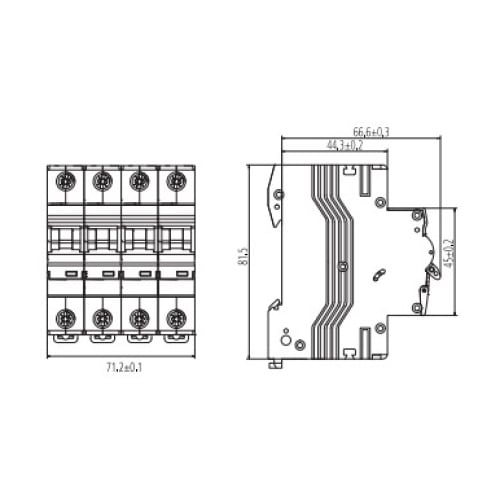
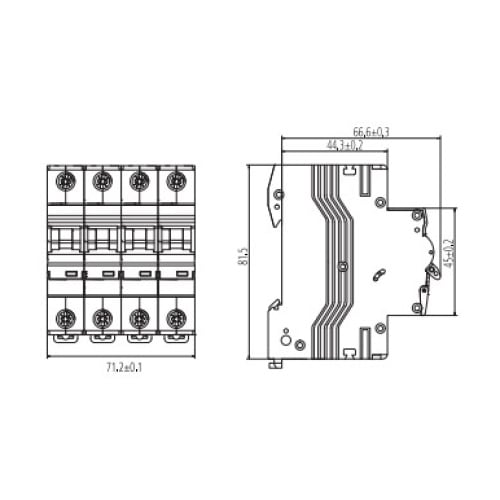
Circuit breakers — also known as automatic circuit breakers — protect circuits against overcurrents and short circuits by cutting off the power supply when the current exceeds the rated amperage. In a photovoltaic installation, they are required on both the AC and DC sides, and they are not the same type of device.
Why doesn’t an AC circuit breaker work with direct current?
Because of the way the arc is extinguished. In an alternating current circuit, the current passes through zero one hundred times per second, and the arc that forms when the contacts open is extinguished only at that instant. In a direct current, the current never passes through zero: the arc persists and may cause the contacts to melt if the device is not designed to interrupt it.
That is why a DC circuit breaker contains arc-extinguishing chambers and permanent magnets that blow out the arc, and that is why has polarity: You must observe the correct polarity for the input and output. Fitting one the wrong way round, or using an alternator in the panel circuit, poses a real fire hazard – it is not simply an inaccuracy in the manual.
What size circuit breaker do I need?
The size is chosen to be greater than the circuit’s operating current and less than the capacity of the cable it protects. That is the rule that governs everything else: The circuit breaker protects the cable, not the appliance.
On the AC side, the operating current is drawn from the inverter’s output: a 5 kW single-phase inverter delivers around 22 A, so a 25 A circuit breaker is the natural choice, provided the cable cross-section can handle that current.
In continuous mode, the calculation is based on the string short-circuit current (Isc) multiplied by the safety factor specified in the standard, never on the rated current. A module with an Isc of 14 A will not be adequately protected if set to 16 A.
Curve B, C or D?
The curve defines how much instantaneous overcurrent the circuit-breaker can tolerate before tripping via the magnetic component:
- Curve B: It draws between 3 and 5 times the rated current. For non-spiking resistive circuits: lighting, sockets, resistors.
- Curve C: between 5 and 10 times. This is the standard type for domestic use and the one we fit as standard: it can handle the start-up of small motors and the inrush current from switching power supplies.
- Curve D: between 10 and 20 times. For loads with high inrush currents, such as large motors or transformers.
The typical fault in installations with an inverter is not a curve fault but a connection current: When powering up an inverter with input capacitors, the initial peak may cause a properly rated B-curve to trip in steady-state operation.
What cutting power do I need?
The breaking capacity (6 kA, 10 kA) is the maximum short-circuit current that the device can interrupt without being destroyed. It depends on how close the circuit is to the utility’s transformer: in a property with a standard connection, 6 kA is sufficient and that is what the regulations require; at the head of large installations or near the substation, the limit is increased to 10 kA.
We have the following in our catalogue: circuit breakers Maxge Alpha+: bipolar fuses rated from 6 A to 40 A with a C-curve and 6 kA, and quadripolar fuses rated up to 63 A with 10 kA, in accordance with ITC-BT-22 and ITC-BT-23.
Circuit breaker or fuse on the DC side?
Both provide protection, but they do not do the same thing. The fuse It is faster and safer in the event of high short-circuit currents, and is used in battery protection, where fault currents are enormous. The thermal-magnetic It can be reset and allows you to isolate the circuit whilst working, which is exactly what you want when working on switchboards.
In practice, the following are used in combination: a battery fuse, a circuit breaker or isolator on the DC strings, and a circuit breaker on the AC circuits.
Not sure which gauge and bend to use on each circuit? Our technical equipment It tells you so. Also check the cable cross-section calculator, because the calibre and cross-section are chosen together.