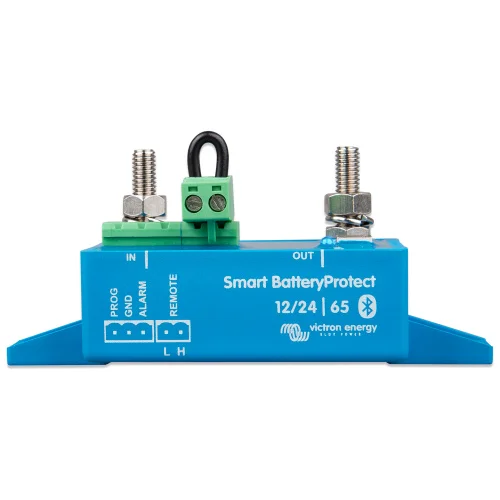
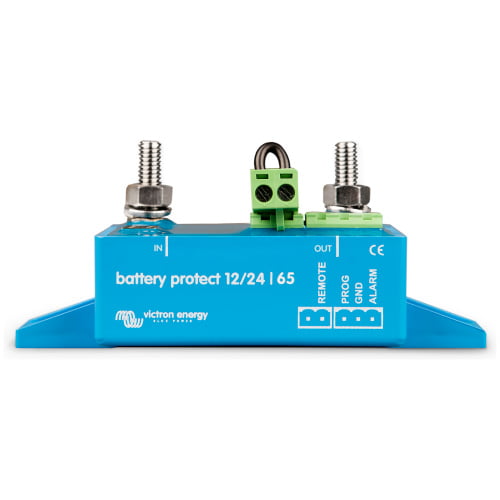
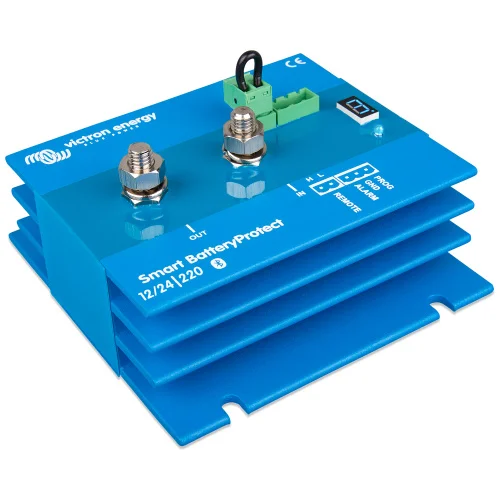
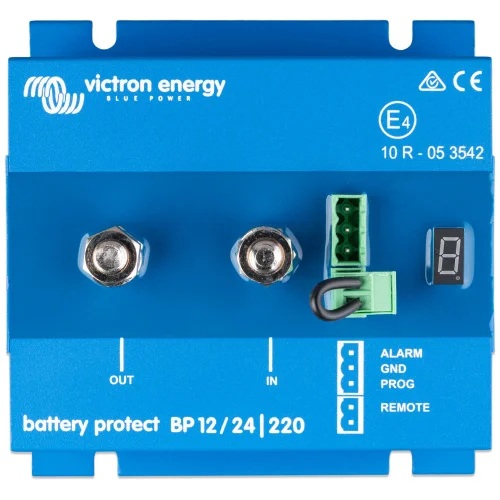
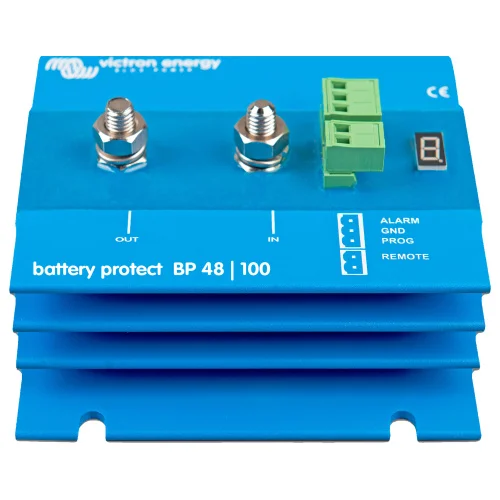
A battery protector is a device that disconnects loads when the battery bank falls below a certain voltage threshold, preventing the battery from discharging below its safe limit. In lithium batteries, this is managed by the BMS, but in lead-acid, AGM and gel batteries, it is the only way to prevent the battery bank from being ruined if you forget to top it up.
Why battery protection is necessary
A lead-acid battery discharged to below 50 % loses its cycle life at an accelerated rate; if it remains below 20 % for days, it usually does not recover. Simply leaving the fridge switched on in a parked van for a week is enough to lose an entire battery bank.
The protector monitors the voltage and breaks the load circuit before it reaches that point, always leaving sufficient reserve power for the system to start up again when the load returns. It is an inexpensive component that protects a more expensive one.
Battery protector or BMS
They are not the same, although they are sometimes confused. The BMS It manages a lithium battery internally: it balances cells and cuts off power in the event of overcharge, over-discharge or excessive temperature. The battery protector operates on the load side and works with any battery chemistry.
In a lithium system with an integrated BMS, the circuit breaker remains useful for a practical reason: when the BMS cuts off the power, it does so abruptly, leaving everything without power. A circuit breaker set above that threshold first disconnects non-critical loads in an orderly manner, leaving the system in a state from which it can be restored.
How to work out the correct size
Based on the maximum current of the loads it will protect. A 65 A circuit breaker covers the lighting, pump, fridge and sockets in a campervan; for a inverter For certain power ratings, 100 A models or higher will be required, or the inverter will need to be connected separately with its own threshold.
The Smart models from Victron They allow the cut-off and re-engagement voltages and the delay to be adjusted via Bluetooth, which is important to prevent the device from tripping due to the momentary voltage drops caused by a motor starting up.
What does it go with?
With a battery monitor To find out the actual state of charge —voltage alone can be misleading—, your fuse the appropriate one and a cable of the correct cross-section.
Tell us which devices you want to protect and what type of battery you use, and we’ll tell you the model: technical advice free of charge.