
ANL fuses
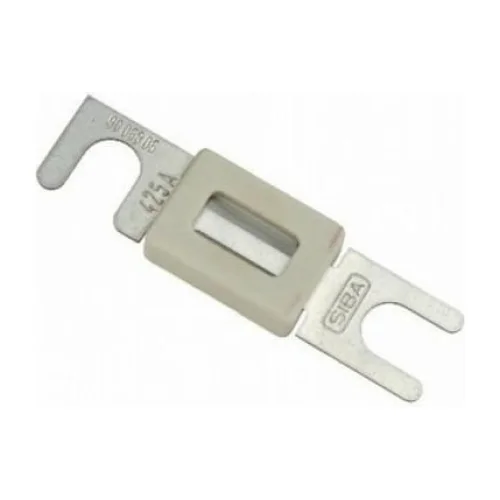
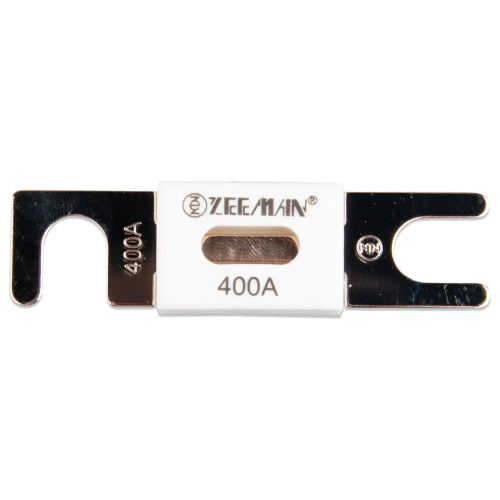
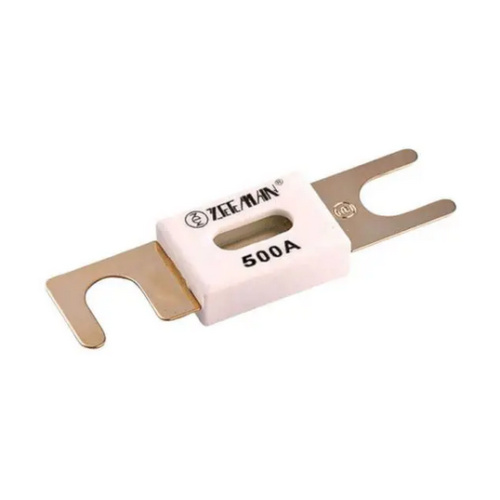
ANL fuses are high-current DC blade fuses, the standard choice for protecting the main circuit between the battery and the inverter in campervan, marine and off-grid installations. They cover ranges from 35 to 750 A and are the type you’ll see in almost any Victron diagram.
What is an ANL fuse used for?
Its natural place is on the cable with the largest cross-section in the installation: the one running from the battery’s positive terminal to the inverter or the main distribution board. Very high currents flow through this cable — a 2,000 W, 12 V inverter can draw more than 170 A — and an unprotected short circuit will result in a fire.
The ANL fuse is fitted in its fuse holder as close as possible to the battery terminal. This proximity is key: the section of cable between the battery and the fuse is the only part that is unprotected, so it must be as short as possible.
How do you choose the amperage?
The fuse protects the cable, not the appliance. It is rated for a current higher than the maximum operating current but lower than the cable’s current-carrying capacity.
The procedure is as follows: calculate the maximum current that will flow — power divided by voltage, allowing for the peak —, then select a cable cross-section capable of withstanding it using the Cross-section table by power rating, and fit a fuse between that maximum current and the cable’s current rating.
Example: a 12V, 2,000 W inverter With an efficiency of 90 %, it requires around 185 A continuous current. 50 mm² cable and a 250 A ANL fuse.
ANL, MEGA or MIDI
All three are high-current DC fuses and differ in terms of their rating range and format. The MIDI range from 30 to 200 A in a compact format; the MEGA They reach 500 A and are commonly used in distribution systems; ANLs cover the widest range and are the most widely used in mobile photovoltaic installations.
The important thing, regardless of the type, is that they are approved fuses for direct current: a fuse designed for alternating current does not effectively cut off a direct current arc and may fail to interrupt the fault.
If you tell us which charger and which battery you’re going to use, we’ll tell you which fuse and what cable gauge you need: technical advice free.