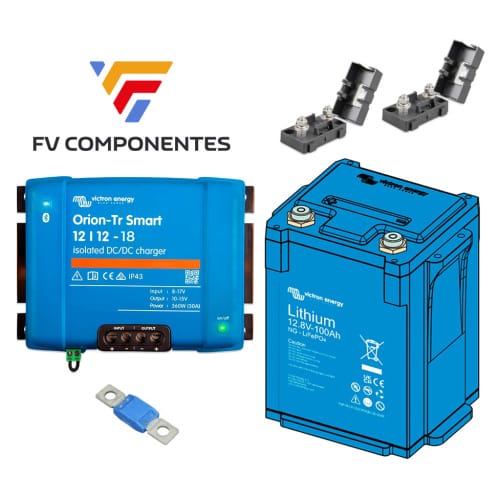
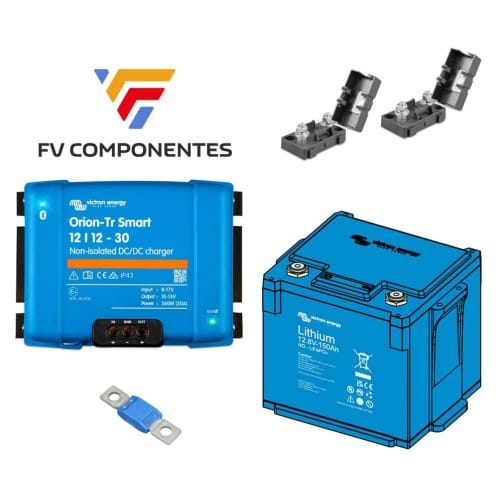
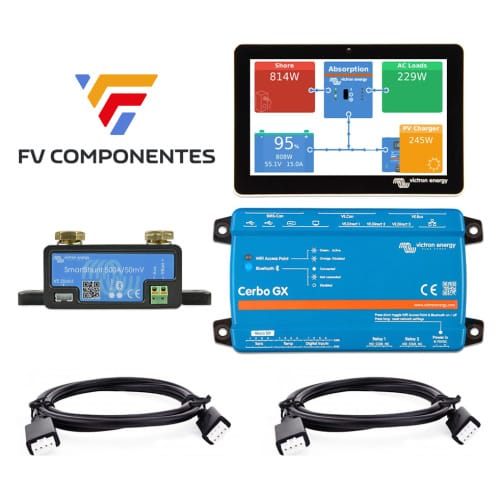
A solar kit for campervans solves the problem of electrical autonomy in a campervan or motorhome in one go: panel, regulator, battery, charger and protective devices, all matched to each other and ready to fit. Here you’ll find complete electrical kits for campervans with components Victron Energy, ranging from a basic set-up to a system with a 3,000 W inverter and 300 Ah lithium batteries.
What’s included in a campervan solar kit?
A complete kit contains five blocks. The solar panel, which produces; the MPPT controller, which adapts that output to the battery; the service battery, which stores; the DC-DC booster, which is charged by the alternator whilst you’re driving; and the inverter, which supplies 220 V for anything that doesn’t run on 12 volts.
On top of that, there are the bits that hardly anyone mentions and are always missing: fuses, fuse holders, cable of the correct cross-section, terminals and a monitor to tell you exactly how much battery life you have left. In our kits, all of this is included and factored in.
What solar kit do I need for my campervan?
The sizing is based on daily consumption, not on the available ceiling area.
Basic usage —lights, a water pump, charging mobile phones and a small fridge—: around 400–600 Wh per day. This is covered by a 150–200 W solar panel and a 100 Ah lithium battery.
Average usage —compressor fridge running all day, laptop, shower and auxiliary heating—: 800–1,200 Wh/day. You’ll need a 300–400 W solar panel and a 200 Ah lithium battery.
Living in a campervan all year round, with an induction hob, coffee machine or air conditioning: over 2,000 Wh/day. Here we’re talking about a solar panel of 500 W or more, a 300 Ah lithium battery and a 3,000 W inverter-charger, and it’s usually advisable to upgrade the system to 24 V.
Bear in mind that in winter, in December, a solar panel produces around a third of what it does in July. If you’re going to be travelling all year round, base your calculations on the figures for the worst season, or make sure you can top up using the alternator and the mains supply.
Why choose Victron for a campervan?
Because the whole system communicates with each other. The regulator, the booster, the inverter and the battery monitor are all configured via your mobile phone using Bluetooth; they share information and operate as a single unit rather than as five separate devices. When something goes wrong, you know exactly what’s wrong.
Add to that the fact that Victron’s documentation is publicly available and comprehensive, that spare parts are available, and that a unit bought today will still have firmware updates and support in ten years’ time. In a van that you’re going to use far from home, that’s worth more than saving a hundred euros at the time of purchase.
Solar kit for motorhomes and sailing boats
The approach for motorhomes is the same, but with a larger roof area and higher fuel consumption. In boating, two things change: corrosion, which requires suitable materials, and the fact that the engine is used less, which makes solar power all the more important. We also have solar kits for sailing boats designed for that purpose.
Assemble it yourself or let us do it for you
Our kits come with a wiring diagram and the cable lengths have been calculated for you. If you’re putting it together yourself, you’ll find the Victron MultiPlus diagram and the cable cross-section table to check your installation.
And if you’d rather start with individual components, have a look at them separately: 12V lithium batteries, MPPT controllers, DC-DC boosters e 12V to 220V inverters.
Tell us what van you have and how you use it, and we’ll tell you which kit is right for you – or we’ll put together a bespoke solution for you. Technical advice free.