
Trina
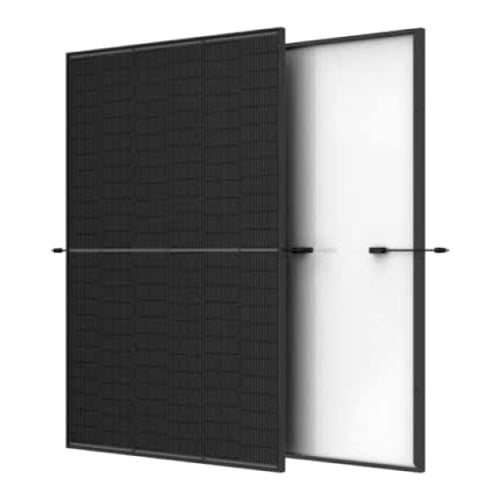
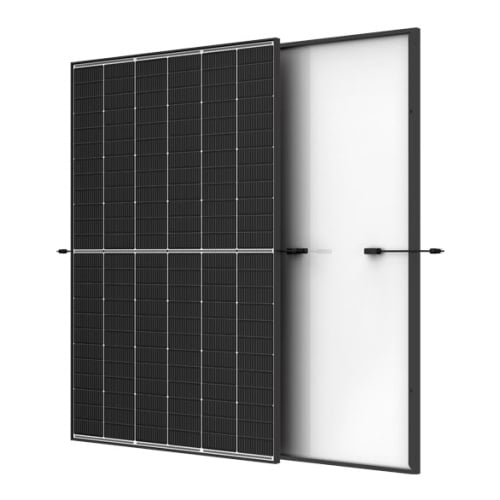
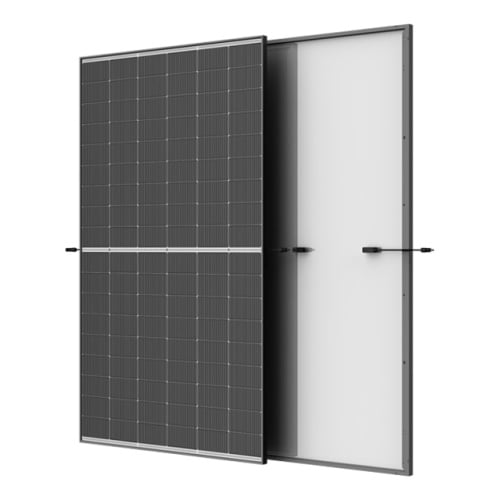
Trina Solar It is one of the world’s five largest manufacturers of photovoltaic modules. Founded in 1997 in Changzhou, it has accumulated more than 200 GW of installed capacity across over 100 countries and has been a Bloomberg Tier 1 company since 2013. In Spain, it is one of the brands most frequently installed by professional installers, thanks to its balance of efficiency, price and a robust warranty.
At FV Componentes, we work with the current range n-type TOPCon, in stock in Spain with delivery within 24–48 hours.
Which Trina solar panels do we have in our catalogue?
- Trina 455W Vertex S+ NEG9R.25 Full Black: Compact residential design with an all-black finish, for exposed roofs.
- Trina 465W Vertex S+ NEG9R.28: the same residential design with slightly more power per module.
- Trina 515W TSM-NEG18R.28: medium-sized, offering a good balance between power and manoeuvrability.
- Trina 640W NEG19RC.20: large-format roofing for commercial and industrial buildings.
- Trina 730W NEG21C.20U: the most powerful module in the range, for ground-mounted and large rooftop installations.
What does it mean for a Trina panel to be n-type TOPCon?
TOPCon (Tunnel Oxide Passivated Contact) adds an ultra-thin layer of oxide and doped silicon to the rear surface of the cell, which reduces carrier recombination at the contact. On a silicon substrate n-type, which translates into three measurable advantages over the previous-generation p-type PERC: higher cell efficiency, most favourable temperature coefficient and lower annual degradation, as well as being unaffected by the LID effect.
The difference is particularly noticeable in summer: when the cell is at 65 °C, a module with a better thermal coefficient delivers several percentage points more output than one with an equivalent nominal power rating.
Which Trina panel should I choose for my installation?
For residential roofing, the 455 W and 465 W Vertex S+ models: they are smaller, lighter and can be installed by a single person on a pitched roof. The all-black version is the best choice when the roof is visible from the street.
For commercial premises or warehouse, the 640 W and 730 W models reduce the number of modules, structures and connections required for the same installed power, which is where time is saved during installation.
Be careful with large-format panels in residential settings: a 730 W module is over two metres long, and handling it on a sloping roof in windy conditions is awkward and risky.
Trina or AIKO? Trina or LONGi?
AIKO It leads the way in efficiency per square metre thanks to its ABC back-contact technology, and is the go-to choice when roof space is limited. It costs more per watt.
LONGi and Trina compete in the same TOPCon market, with differences lying more in availability and price than in technology.
Our view: if you have plenty of space, Trina offers the best balance of price, warranty and manufacturer support. If every square metre counts, it’s worth paying the premium for AIKO.
What is the warranty on Trina panels?
The current range offers product warranty —manufacturing defects— and linear performance guarantee, which guarantees a minimum power output for 25–30 years. These are two distinct things that should not be confused: the product warranty covers module failure; the performance warranty covers the module producing less than the guaranteed output.
Check the specifications for each model for the exact years, which vary between series. Need help matching the strings to your inverter? Use our Series and parallel panel calculator or write to us.