
Self-consumption solar panels
“JA 605W solar panel JAM72D40/MB Bifacial (QC4) - JAM72D40-605/MB (QC4)” has been added to your basket. View basket
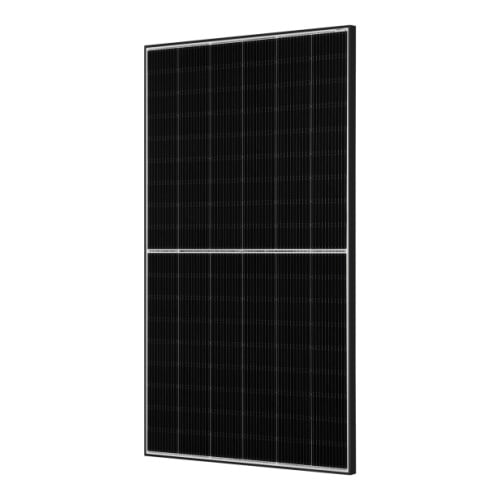
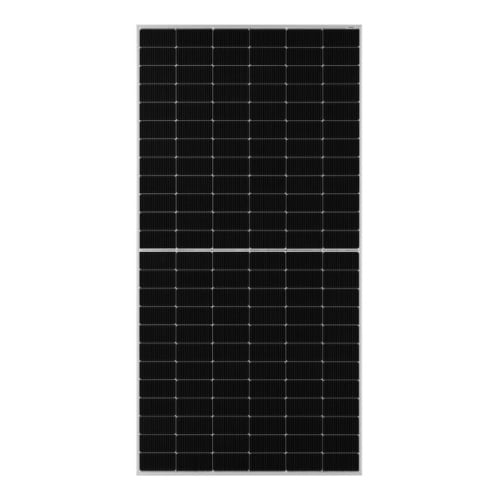
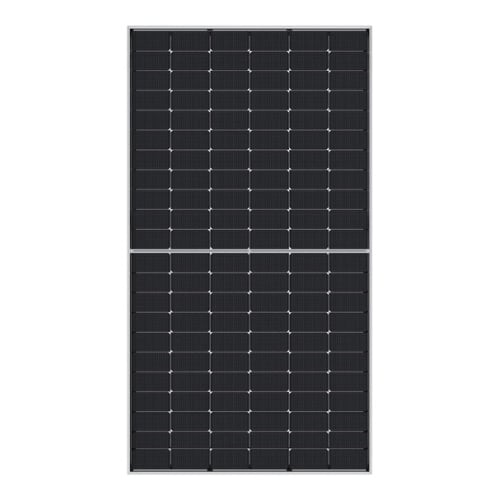
Solar panels for self-consumption are designed for installation on the roof of a house or industrial building connected to the electricity grid. They operate at high voltages, are connected in series to form strings, and feed a grid-tied or hybrid inverter which feeds the electricity generated directly into your home’s electricity consumption.
What is the difference between a self-consumption panel and a 12 or 24V panel?
Voltage and size. A typical self-consumption solar panel has between 108 and 144 cells, delivers 400 to 600 W and operates at around 30–45 V. By connecting several in series, the 300–600 V required by a grid-connected inverter is achieved, which significantly reduces the current and therefore losses in the cabling.
That is why they cannot be used to charge a 12 or 24 V battery directly: that is what 24V panels with an MPPT controller.
How much power should be installed?
In Spain, the general rule of thumb is that each kWp installed produces between 1,400 and 1,700 kWh per year, depending on the province, the orientation and the tilt. A home with an annual consumption of 4,000 kWh can be reasonably covered by 3 kWp; one with 8,000 kWh by 5 or 6 kWp.
Over-sizing without batteries leads to diminishing returns: the energy you generate in excess of what you’re currently using is fed into the grid at a price far lower than what you pay. If you’re going to install more capacity than you use at midday, consider a hybrid inverter with batteries.
How they connect
The panels are grouped into series strings, and the number of panels per string is determined by the inverter’s voltage range. This must be calculated using the open-circuit voltage on the coldest day of the year, because cold temperatures increase this voltage and exceeding the inverter’s maximum rating will damage it.
If your roof has partial shade or faces in different directions, consider using optimisers or an inverter with several independent MPPT trackers.
What else does the installation need?
Structure suitable for your roof —tiles, metal sheeting, decking—, solar cable, connectors, surge protection continuous and alternating, and the self-consumption inverter. We are Fronius System Partner and Authorised Service Centre in Spain.
Tell us the property’s annual energy consumption, the orientation of the roof and whether you’d like batteries, and we’ll suggest a configuration: technical advice free.