How many ZYC SIMPO 5000 batteries do I need, depending on my inverter?
Author: David Conesa Albaladejo
Publication date: 8 September 2026
Last updated: 8 September 2026
This is the question we’re asked most often when someone is sizing up a storage system: How many batteries can I use without running out? And the answer does not depend on the number of kWh you want to store, but on the the amount that your investor is able to borrow from the bank.
ZYC publishes a list of recommended minimum settings by inverter model. Here is a translated and organised version, explaining what each figure means. The data is from the List of Recommended Minimum Configurations for the EU, Version 2.3 from the manufacturer.
Why is there a minimum number of batteries?
Each module ZYC SIMPO 5000 delivery 100 continuous amps and up to 200 A peak for 5 seconds. A large inverter may require more than that: if the array does not have enough modules, the BMS trips due to overcurrent and the system shuts down just when it is needed most.
That is why the minimum depends on four factors: the inverter’s power rating, whether it is single-phase or three-phase, and whether it operates plugged in (where the grid helps during peak demand) or isolated (where the battery is the sole source of power). In off-grid mode, the minimum is always higher.
Manufacturer’s notice: Deviating from these figures in the downward direction is not permitted. And if you are going to start engines, pumps or compressors, bear in mind that more modules that meet the minimum requirement: the inrush current may be several times the rated current.
Victron Energy
Victron model
Jumpsuit. net
Overalls. Isolated
Tri. net
Isolated Tri.
MultiPlus 48/1600/20
1
1
1
2
MultiPlus 48/2000/25
1
1
1
2
MultiPlus 48/3000/35
1
1
2
3
MultiPlus 48/5000/70
1
2
2
4
MultiPlus-II (GX) 48/3000/35-32
1
1
1
3
MultiPlus-II (GX) 48/5000/70-50
1
2
2
4
MultiPlus-II 48/8000/110-100
1
3
3
7
MultiPlus-II 48/10000/140-100
2
3
3
8
MultiPlus-II 48/15000/200-100
2
4
4
12
Quattro 48/5000/70-100/100
1
2
2
4
Quattro 48/8000/110-100/100
1
3
2
7
Quattro 48/10000/140-100/100
2
3
3
8
Quattro 48/15000/200-100/100
2
4
4
12
EasySolar-II 48/3000/35-32 MPPT 250/70 GX
1
1
2
3
EasySolar-II 48/5000/70-50 MPPT 250/100 GX
1
2
2
4
For Victron, ZYC recommends the cable VE.Can to CAN bus Type A BMS for communication. If you’re going to work without communication, you’ll have the voltage values in the Victron setup guide with ZYC SIMPO 5000.
Deye
Deye model
Network
Isolated
SUN-3.6K-SG01LP1-EU
1
1
SUN-5K-SG01LP1-EU
1
2
SUN-6K-SG01LP1-EU
1
2
SUN-8K-SG01LP1-EU
1
2
SUN-12K-SG01LP1-EU
2
3
SUN-16K-SG01LP1-EU
3
4
SUN-5K-SG04LP3-EU (three-phase)
1
2
SUN-8K-SG04LP3-EU (three-phase)
2
2
SUN-12K-SG04LP3-EU (three-phase)
2
3
SUN-20K-SG05LP3-EU-SM2 (three-phase)
5
6
SMA, Studer, Goodwe and Solis
Make and model
Jumpsuit. net
Overalls. Isolated
Tri. net
Isolated Tri.
SMA Sunny Island 4.4M
1
2
3
4
SMA Sunny Island 6.0H
2
2
4
6
SMA Sunny Island 8.0H
2
3
5
8
Studer XTM 4000-48
1
1
2
4
Studer XTH 6000-48
1
2
3
5
Studer XTH 8000-48
2
3
4
7
Studer Next3 / Next3 Rack
—
—
3
4
Goodwe GW5000-ES-20
1
2
—
—
Goodwe GW10K-ES-C10
2
3
—
—
Solis RHI-5K-48ES-5G
1
2
—
—
The manufacturer’s full list also includes Selectronic, Steca Xtender and Noark. If your model isn’t listed here, please get in touch and we’ll look into it.
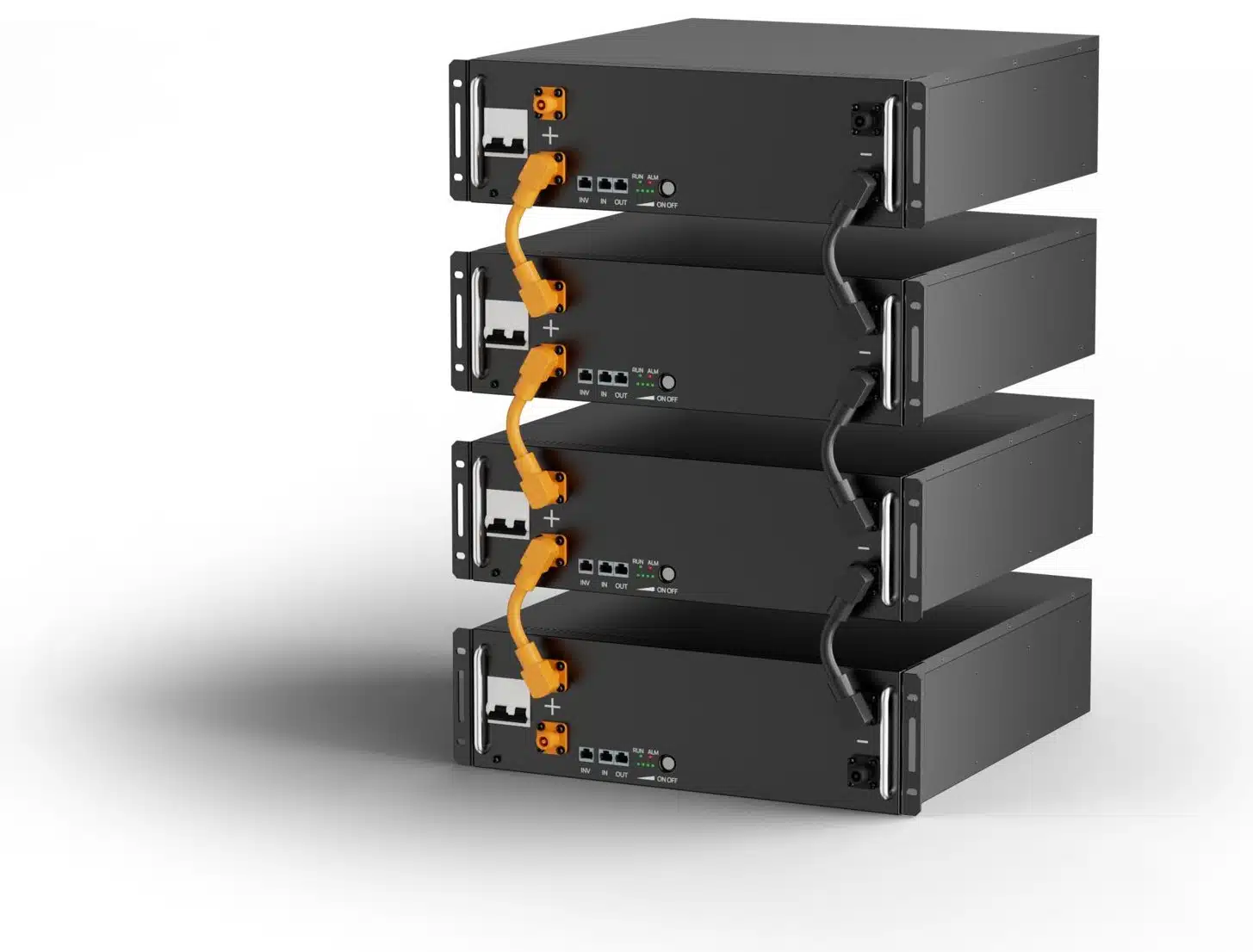
Four modules: 20.5 kWh and 400 A continuous current.
How to apply this in a real-world project
Example 1 — a home with a MultiPlus-II 48/5000 connected to the mains. The minimum is 1 module, i.e. 5.12 kWh. It works, but with just one module you’ll be at the current limit: for a home with normal consumption, 2 or 3 modules are a sensible choice, and that way you’ll also have real autonomy.
Example 2 — the same inverter in an off-grid installation. The minimum rises to 2 modules. If there is a well, a pump or an air-conditioning unit, it counts as 3 or 4.
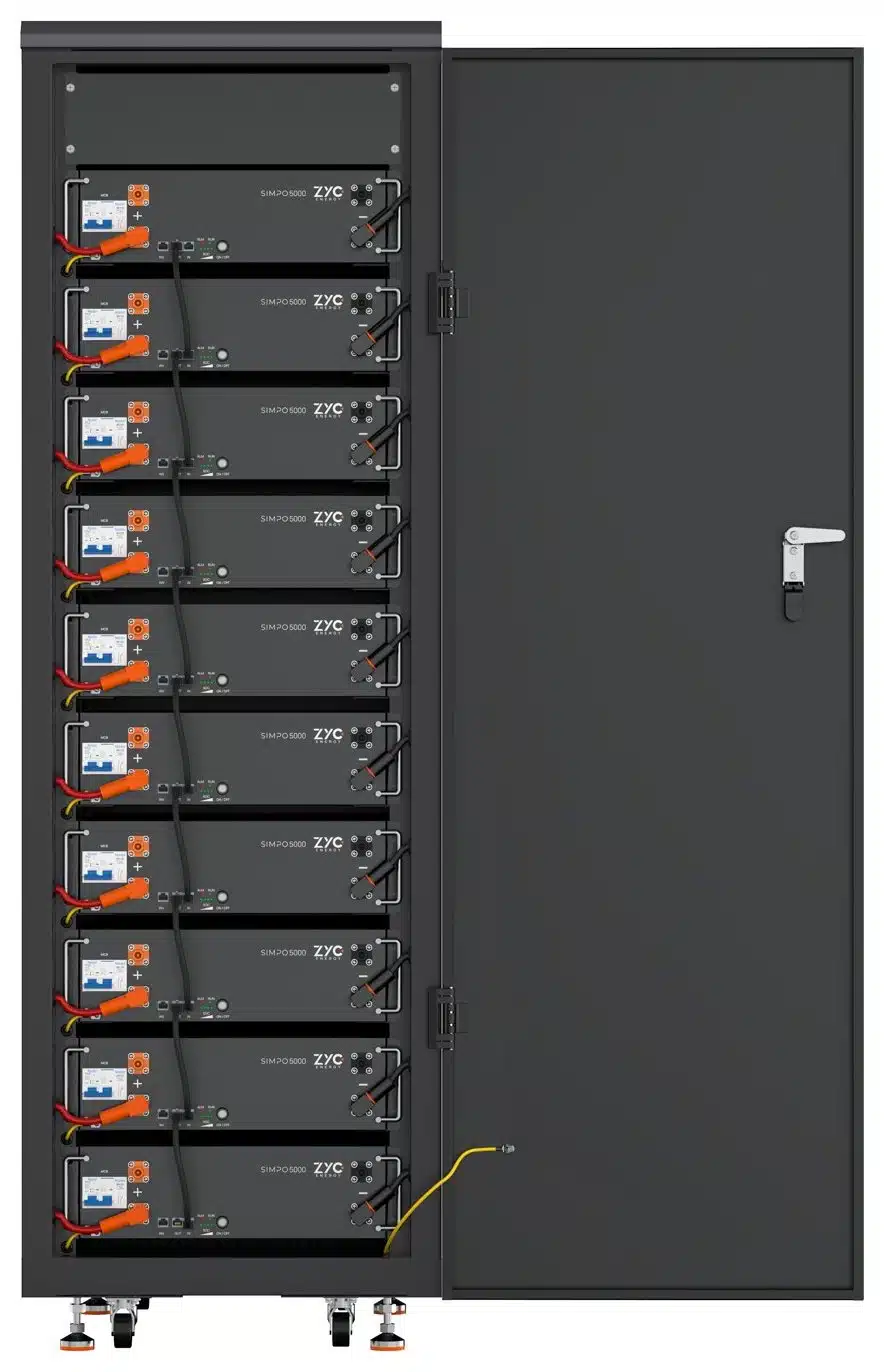
Example 3 — warehouse fitted with an isolated three-phase Quattro 48/15000. The minimum is 12 modules, around 61 kWh: at this point you’re talking about 10-unit cupboard further expansion, not a single tower.
10-module cabinet: 51.2 kWh and busbar output up to 1,000 A.
How far can you go?
The system supports up to 80 modules in parallel on a single inverter without external control devices. When you connect several cabinets via a DC combination box, the manufacturer sets the maximum at 64 modules. In either case, these figures are well above what a home requires: the practical limit is set by your investor, not the battery.
Quick tips to help you get it right
Never go below the minimum from the table, even if the kWh figures add up.
In isolation, a significant margin: Motor and compressor starts do not appear on the consumption sheet but do appear in the BMS.
Cables of the same length for all modules, so that the impedance is the same and the current is distributed evenly.
With several cupboards, a DC combination box and power cable lengths of approximately the same length.
Communication cable, maximum 5 m long, shielded Cat5 or higher.
Do you have any queries about a specific inverter? Tell us the model and the type of installation, and we’ll tell you how many modules you need before you buy.
Recommended settings for configuring the Victron and SmartShunt on the VictronConnect with lithium and lead-acid batteries: discharge limit 5%, Peukert 1.05, tail current 4% and above, with a step-by-step video guide.
The Pylontech US are batteries for domestic use. We’ll explain which certifications a vehicle requires (R10, SAE J1455), how vibration affects them, what the warranty covers, and what happens with insurance in the event of a fire.
Do you have an Android tablet or mobile phone gathering dust in a drawer? With the Victron Energy Android GX WiFi Display app, you can turn it into a fixed wireless display for your Cerbo GX, Ekrano GX or any device with GX built-in. Victron has just released version 1.2, which makes the connection more stable, so
A step-by-step guide to powering CCTV cameras using solar energy on farms, construction sites or industrial premises without mains electricity: power consumption, batteries, solar panels, 4G and common pitfalls to avoid.
We use our own and third-party cookies to obtain statistical data on our users' browsing habits, offer personalised marketing and improve our services.
Functional
Always active
The storage or technical access is strictly necessary for the legitimate purpose of enabling the use of a specific service explicitly requested by the subscriber or user, or for the sole purpose of carrying out the transmission of a communication over an electronic communications network.
Preferences
The technical storage or access is necessary for the legitimate purpose of storing unsolicited preferences of the subscriber or user.
Statistics
Technical storage or access that is used exclusively for statistical purposes.Technical storage or access that is used exclusively for anonymous statistical purposes. Without a request, voluntary compliance by your Internet Service Provider, or additional records from a third party, information stored or retrieved solely for this purpose cannot be used to identify you.
Marketing
Technical storage or access is necessary to create user profiles to send advertising, or to track the user across a website or across multiple websites for similar marketing purposes.