The solar battery market has changed radically over the last five years. Whereas a decade ago the choice was between lead-acid and lead-acid, today the right question is not whether to choose lithium, but what type of lithium and, more importantly, which specific model is the most suitable for your system.
In this guide, I go into detail about LiFePO4 technology, why it is the standard choice for solar installations, and what you need to know before integrating lithium batteries into a system with a Victron inverter.
Why lithium rather than lead for a solar installation?
The comparison between LiFePO4 lithium and lead-acid (AGM or gel) batteries is not just about price — it’s about the installation philosophy.
| Parameter | LiFePO4 | AGM / Gel |
|---|---|---|
| Life cycles (80% DOD) | 3.000 – 5.000 | 500 – 800 |
| Useful discharge depth | 80 – 100% | 50% – maximum recommended |
| Actual usable capacity | 100% of the nominal value | ~50% of the nominal value |
| Weight for the same amount of useful energy | ~3 times lighter | — |
| Monthly self-discharge | <3% | 3 – 5% |
| Maintenance | None | None (AGM) / minimal (gel) |
| Initial cost | Mayor | Menor |
| Total cost over 10 years | Lower | Superior (2–3 substitutions) |
The conclusion is clear: For a new installation under normal use, the TCO of lithium batteries is lower than that of lead-acid batteries over an 8–10-year period, even taking into account the initial additional cost. The only reasonable exception is for installations that are used very sporadically and have low energy consumption.
Types of lithium batteries: they’re not all the same
The term «lithium battery» encompasses several technologies with very different characteristics. In the context of solar installations, there are three that are important:
LiFePO4 — Lithium iron phosphate
It is the de facto standard for residential and commercial solar storage. Its technical specifications make it the right choice in virtually all scenarios:
- Exceptional chemical stability: with no risk of thermal runaway under normal conditions of use. The safest of the lithium chemistries.
- 3,000–5,000 cycles at a discharge depth of 80%.
- Wide operating temperature range: -20°C to +60°C (discharge), 0°C to +45°C (charge).
- Compatible with Victron’s DVCC protocol via VE.Bus (Victron NG batteries) or CANbus (Pylontech, Pytes).
⭐ Recommended for: any new solar installation, whether domestic, commercial or for a camper van.
NMC — Nickel, manganese and cobalt
Higher energy density than LiFePO₄ (more kWh per kg), making it popular in electric vehicles where weight is a critical factor. However, it is less chemically stable (greater risk of thermal runaway) and has a shorter cycle life (1,000–2,000 cycles).
In fixed solar installations, where weight is not a determining factor, LiFePO4 outperforms NMC in terms of safety, longevity and total cost. It is not the usual choice for a building plot.
LTO — Lithium titanate
Technology offering extremely long service life (15,000–25,000 cycles) and capable of operating at extreme temperatures (-30°C). The problem: very low energy density (it requires twice the volume for the same amount of energy) and very high cost. Its niche lies in critical industrial applications.
For residential or campervan use, beyond one’s means.
The BMS: the most important component that nobody mentions
A LiFePO4 battery without a suitable BMS (Battery Management System) is a battery that will degrade prematurely or, in the worst-case scenario, a dangerous battery.
The BMS has three key functions:
- Cell protection: It detects and cuts off the charging or discharging process if a cell exceeds the voltage, temperature or current limits.
- Balance: It balances the load between cells to maximise the pack’s total capacity and prevent weak cells from limiting the performance of the others.
- Communication with the investor: In systems with DVCC, the BMS transmits the charge/discharge limits to the inverter/charger in real time. This is what sets Victron systems apart.
Integrated BMS vs External BMS
High-quality batteries (Victron LiFePO4 NG, Pylontech, Pytes) come with a built-in BMS. You don’t need to buy or set up anything else.
Low-cost batteries without an integrated BMS or with a generic BMS lacking a standard communication protocol require the charging parameters to be configured manually on the inverter — and without real-time feedback, the margin for error is considerable.
Victron DVCC Protocol
When DVCC is enabled on the Cerbo GX and the battery has a BMS that can communicate (via VE.Bus or CANbus), the following occurs:
- The BMS sends the exact values of CCL (Charge Current Limit) and DCL (Discharge Current Limit) in real time.
- The inverter automatically adjusts its charging current in accordance with these limits.
- If the BMS detects a problem (hot cell, overheating), it can cut the load in a controlled manner without shutting down the entire system.
The result is a system in which the battery actively protects itself, rather than relying on fixed parameters set manually.
Comparison of the best models for Victron systems
This is where practical experience counts. These are the three models we work with at FV Componentes, which operate correctly in Victron systems with DVCC enabled:
| Model | Tension | Capacity | Communication | Expandable |
|---|---|---|---|---|
| Victron LiFePO4 NG | 12.8V / 25.6V | 50–300 Ah | Native VE.Bus | Up to 5 in parallel |
| Pylontech US5000 | 48V | 74 Ah / 3.5 kWh | CANbus (Cerbo GX) | Up to 8 towers |
| Pytes E-BOX-48100R | 48V | 100 Ah / 4.8 kWh | CANbus (Cerbo GX) | Up to 15 modules |
Victron LiFePO4 NG
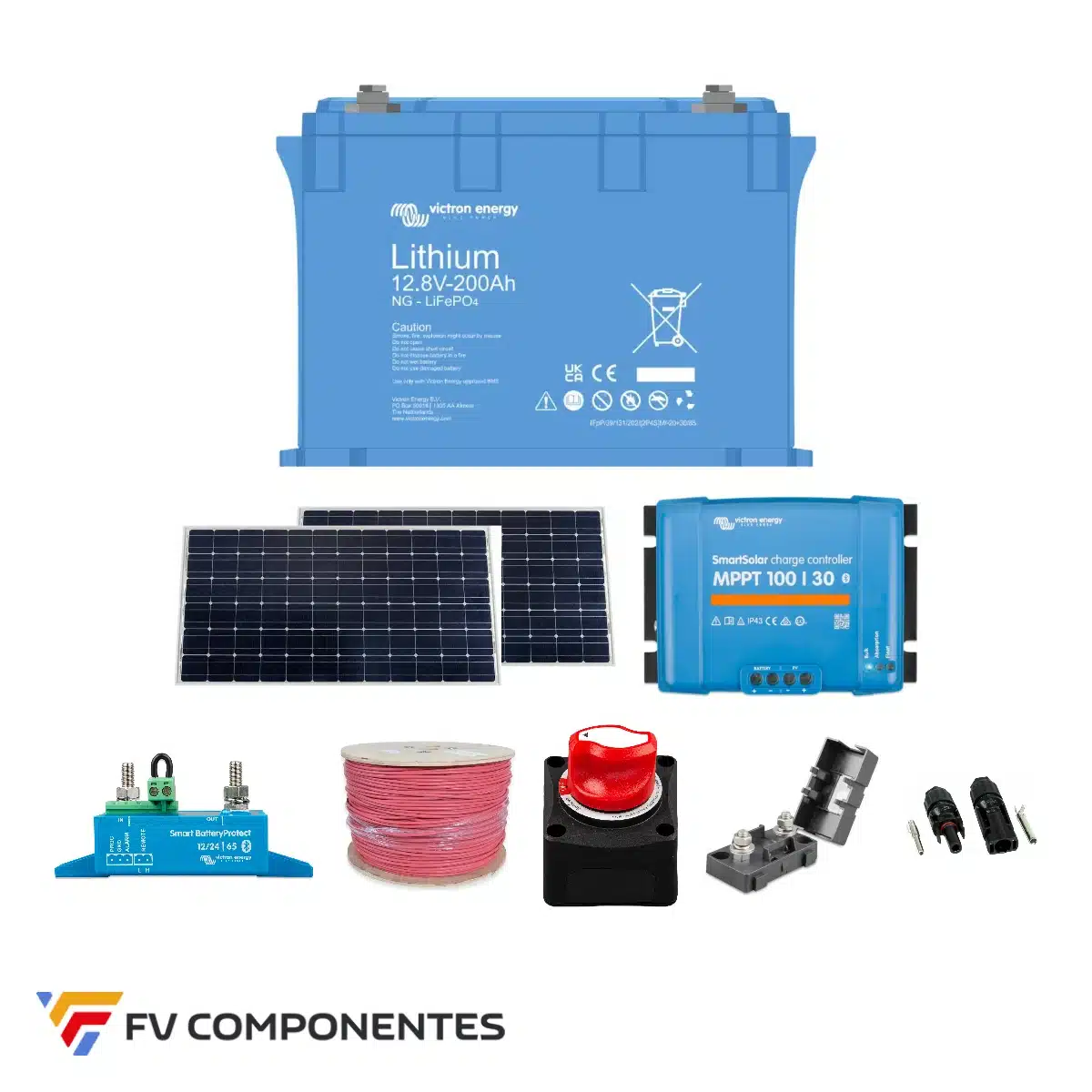
The cleanest option in terms of integration with Victron systems. Native VE.Bus communication, compatible with SmartShunt, MPPT and MultiPlus without the need for additional protocol configuration. Available in 12.8V (ideal for motorhomes, boats and small systems) and 25.6V versions.
The price per kWh is the highest of the three, but integration is fully plug-and-play within the Victron ecosystem.
Pylontech US5000
The market standard for 48V domestic systems. With the Cerbo GX configured to read the BMS via CANbus, integration with the MultiPlus-II and Quattro is seamless. Well-tried and tested, extensively documented on the Victron forums, and offering excellent value for money per kWh.
Pytes E-BOX-48100R
An alternative to Pylontech offering greater capacity per module (4.8 kWh compared to 3.5 kWh in the US5000) at a similar price point. It also communicates via CANbus with Cerbo GX and is officially supported by Venus OS. A particularly attractive option for 10–20 kWh installations where every additional module makes a difference.
Configuring lithium batteries in a Victron system: key points
Once you have the battery, there are four critical parameters that must be set correctly on the MultiPlus/Quattro for the system to work properly:
- Absorption voltage: 14.2V (for 12V systems) / 28.4V (24V) / 56.8V (48V). Do not use the lead-acid absorption voltage (which is higher).
- Floating tension: just like the absorption stage, or deactivated. LiFePO4 lithium does not require float charging, unlike lead-acid batteries.
- Low-voltage cut-off voltage: 11.5V (12V) / 23V (24V) / 46V (48V). This setting protects the battery from over-discharge if the BMS does not intervene first.
- DVCC enabled on Cerbo GX: Essential if the battery has a communicative BMS. It allows the BMS to dynamically control the charging limits.
Important: If you enable DVCC but the battery does not have a communicative BMS, the system may behave unexpectedly. Always check that the Cerbo GX correctly detects the battery on the system summary page.
Frequently asked questions
How long does a LiFePO4 lithium battery for solar power last?
Between 10 and 15 years under normal conditions of use, or 3,000–5,000 full cycles. In a domestic installation with one cycle per day, this equates to a service life of more than 10 years. Standard manufacturer’s warranties for brands such as Victron, Pylontech and Pytes are for 10 years.
Can lithium batteries from different brands be mixed?
No. Mixing batteries of different brands, capacities or charge states causes imbalances in the battery bank that BMS systems cannot manage properly. Always install the same model and add modules from the same manufacturer.
What happens if the temperature drops below 0°C?
LiFePO4 batteries must not be charged at temperatures below 0°C — this can cause lithium metal to deposit on the anodes, which permanently damages the cells. Discharging is, however, permitted down to -20°C. High-quality models (Pylontech, Victron NG) have built-in protection in the BMS that prevents charging at low temperatures.
Do I need an external BMS for Victron LiFePO4 NG batteries?
No. Victron LiFePO4 NG batteries feature a built-in BMS with VE.Bus communication. For systems using Cerbo GX, integration is straightforward and requires no additional components.
Can I use lithium batteries with an older MPPT controller?
Yes, but there are conditions. The regulator must allow the charging parameters for lithium (absorption and float voltages) to be set manually. Victron’s SmartSolar MPPT units have native lithium profiles and, if they are on the same VE.Smart or VE.Direct network, they can receive the charging limits from the BMS automatically.
If you are planning a lithium battery installation and want to ensure that the integration with your Victron system is set up correctly, our technical team can go through it with you before you make your purchase.