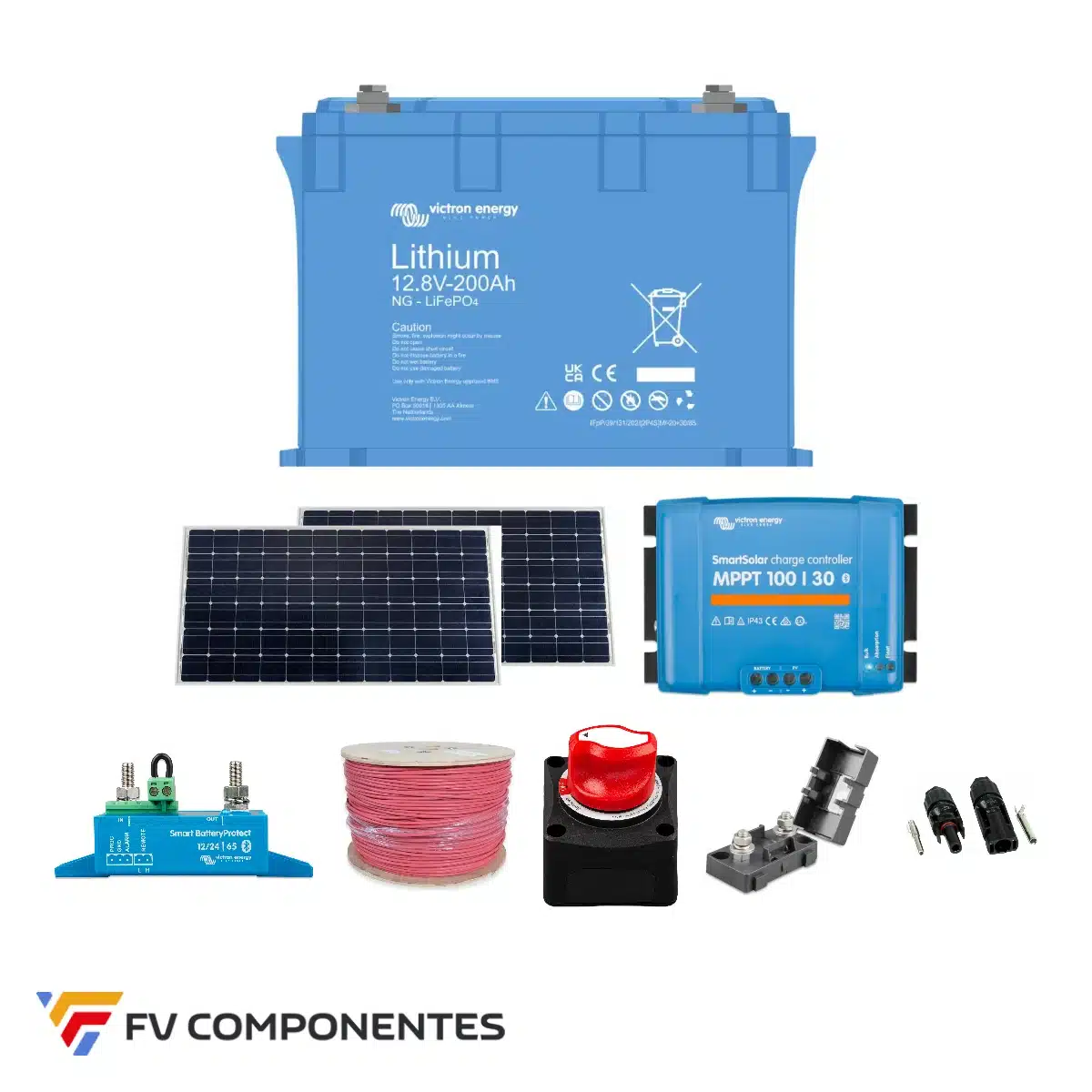
New 12V lithium battery kit for motorhomes: Maximum capacity at the best price
Author: David Conesa Albaladejo
Publication date: 27 June 2026
Last updated: 16 September 2026
Why switch to a lithium battery in your campervan?
Swapping a lead-acid battery for a lithium one marks a turning point for your campervan. LiFePO4 chemistry offers more usable energy, lower weight, faster charging, better voltage stability and a much longer service life than lead-acid. You’ll notice the difference every day: greater real-world range, fewer worries and the peace of mind that comes with a reliable system, even under high power demands.
From lead to lithium
With lead-acid, AGM or GEL batteries, it is recommended to use only 50% of the total capacity so as not to shorten their service life. With lithium batteries, this usable percentage rises to 80–90%. For example: a 12V, 200Ah AGM battery delivers around 1200Wh of usable energy; a lithium battery with half that capacity, 100Ah, already provides around 1000–1100Wh of usable energy. And it’s not just that they have more usable capacity: lithium batteries maintain a much more stable voltage, so sensitive devices such as fridges, inverters or routers operate more efficiently.
Useful energy and voltage stability
The key to comfort in a campervan is the usable power available on a day-to-day basis. Lithium minimises voltage drop during power consumption: the fridge no longer “struggles”, the inverter delivers its full rated power, and the regulator operates within its optimal range. The result is fewer deep discharge cycles and, therefore, a longer service life. Furthermore, lithium batteries charge faster: they can handle higher charging currents (provided the charger and BMS allow it), which is perfectly suited to modern alternators and DC-DC chargers such as the Victron Orion.
💡 In summary: more usable energy, greater real-world range and equipment that performs better, even at peak consumption.
The real advantages of 12V lithium batteries over lead-acid batteries
Weight, size and ease of installation
Lithium weighs between 50 and 70% less than lead for equivalent capacities. In a campervan, where every kilo counts, less weight means more payload for water, bikes or luggage. Furthermore, as they can be installed vertically, horizontally or on their side, LiFePO4 batteries are better suited to the confined spaces of a campervan.
Long-lasting and requires almost no maintenance
A good LiFePO4 battery offers between 2,000 and 4,000 charge/discharge cycles at 80% DoD, compared with 300–600 for an AGM battery. Maintenance is virtually non-existent: no leaks and no need to check the electrolyte. You just need to ensure that the charger is compatible and to set the charging voltages correctly when installing the battery. Otherwise, all that’s required is some ventilation and an occasional check-up.
Range and fast charging whilst on the road
If you cover long distances between stops, you’ll already know that the combination of alternator + booster charger, such as the Victron Orion models, is the best way to ensure your batteries always perform at their best. Thanks to lithium, you can make the most of every minute on the road: they can handle high-power charging for longer, quickly recharging the energy used overnight to power the fridge, lights and comfort features. And when power consumption peaks, the voltage remains stable, giving you longer battery life and the real feeling of having a full battery all day long. Ultimately, lithium is an investment that pays for itself thanks to its convenience, range and reliability.
How to choose the best 12V lithium battery kit for your campervan
The right capacity for your usage
When calculating capacity, think in terms of Wh, not just Ah. A simple way to get it right is to add up your daily consumption and add a 20–30% margin. Follow these steps to work out the battery capacity you actually need:
Make a list of your spending: fridge (40–60W on average → 400–700Wh/day), LED lighting (10–30Wh/day), water pump (20–40Wh/day), laptops (60–120Wh), router (5–10W → 120–240Wh/day), mobile phone charging (5–20Wh/day), etc. The more comprehensive the list, the better.
Add up the consumption figures: as a guide, an average campervan usually costs between 1,000 and 1,500 Wh/day.
Occasional use (at the weekend, small fridge): 100–150 Ah.
Lightweight campervan with occasional remote working: 150–200 Ah.
Heavy use (daily remote working + fridge + inverter for occasional use with a coffee machine or induction hob): 200–300 Ah.
Compatibility with chargers and inverters
Victron lithium batteries are compatible with a wide range of chargers, although we always recommend using those from the Victron ecosystem itself.
When choosing a compatible charger, bear in mind the power source you’ll be using to charge the battery:
230V charger: for charging from the mains. Make sure it supports charging profiles for lithium (LiFePO4). We recommend our Battery chargers 12V to 220V.
Solar controller (MPPT/PWM): for charging from solar panels. It must be configurable for lithium batteries, with the correct absorption/float voltages. As the Victron MPPT controllers.
DC-DC charger powered by the alternator: essential for Euro 5/6 engines fitted with smart alternators, to protect both the battery and the alternator. The Orion Booster They are perfect for this role.
Pure-sine wave inverter/charger: compatible with lithium batteries and configurable with the appropriate charging parameters. It powers 230V loads whilst recharging the battery at the same time. The Victron MultiPlus They are perfect for this task.
Protections: ANL/MIDI fuses, isolators, wiring of the correct cross-section and securely crimped terminals.
Price, performance and long-term savings
Cost per Wh and actual return on investment
At first glance, lead seems cheaper than lithium. But to be fair, you need to compare them in terms of usable Wh and cycle life: switching to lithium involves a higher initial investment, although in return you get a much more durable system.
A simple example (figures are rounded and for illustrative purposes only):
Cost per useful Wh over its lifetime: significantly lower.
In short: you pay more initially, but in the medium term lithium works out cheaper than lead because you don’t have to replace the battery every two years.
Installation and tips for use
What you need to switch from lead to lithium
With our Victron lithium conversion kits, you won’t need anything else. They include everything you need to replace the lead-acid batteries in your system with more durable and efficient lithium batteries. Available in two capacities:
Switch off the power and remove the lead-acid battery.
Check the wiring diagram: cable lengths, the shortest and safest route, earth points, etc.
Fit the fuses near the battery (less than 20 cm away) and make the negative lead the same length as the positive one.
Configure the charging profiles on the 230V charger and the MPPT (absorption voltage approx. 14.2–14.6 V, low or no float voltage depending on the manufacturer).
Install and calibrate the DC-DC booster.
Check the following using a multimeter: voltages, continuity and polarity.
Make a load test (turns on the fridge, lights and a laptop) and monitors them using a shunt or the BMS app.
⚠️ Important: Never connect batteries of different chemistries in parallel (lead-acid + lithium). Use the lithium battery as a separate auxiliary system.
Safety and preventive maintenance
Although lithium batteries require very little maintenance, these tips will help you extend their lifespan and ensure your installation remains safe:
Do not puncture or deform the casing; avoid prolonged exposure to extreme temperatures.
Charging in cold conditions: many BMS systems cut off charging below 0°C to protect the cells. If you’re camping in the snow, consider using heaters or insulating the battery compartment.
Storage: keep the battery at 40–60% charge if you are going to be away for several weeks.
Check the terminals for tightness and corrosion every few months.
If you connect several batteries in parallel, use cables of the same length and cross-section.
A comparison of lithium and lead-acid batteries
Feature
Lithium Battery
AGM / Lead-acid battery
Discharge depth
90%
50%
Life Cycles
+3000
300-500
Weight
Very light
Heavy
Load efficiency
99%
80%
Maintenance
Void
Requires care
More freedom, fewer worries
In the long term, switching from lead to lithium guarantees you maximum usable capacity at the best price. With the right capacity, a reliable BMS and compatible chargers, you’ll stop worrying about where you can plug in and start enjoying your journey with peace of mind. That’s the true value of lithium: travelling without limitations.
Ready to upgrade your campervan?
Get one of our lithium conversion kits and enjoy a longer range on your journeys.
Frequently asked questions
What capacity do I need to last 1–2 days without recharging? Between 100 and 150Ah is usually enough for a fridge, lights and mobile phones. If you’re also working from home or using a microwave, aim for 200Ah.
Can I use my current solar regulator and charger? Only if they support a LiFePO4 profile or are configurable. If not, change them so as not to shorten the lithium battery’s lifespan.
Is a DC-DC converter from the alternator required? In smart alternators (Euro 5/6), yes. It protects the alternator and ensures correct and rapid charging.
Is lithium dangerous? LiFePO4 is very stable provided the BMS is of good quality and the protective circuits are correctly rated. Fit fuses and use suitable cable.
Can I keep the lead-acid battery as a backup? It’s best not to mix battery types in parallel. You can keep the starter battery separate and use the lithium battery solely as a backup.
Recommended settings for configuring the Victron and SmartShunt on the VictronConnect with lithium and lead-acid batteries: discharge limit 5%, Peukert 1.05, tail current 4% and above, with a step-by-step video guide.
The Pylontech US are batteries for domestic use. We’ll explain which certifications a vehicle requires (R10, SAE J1455), how vibration affects them, what the warranty covers, and what happens with insurance in the event of a fire.
Do you have an Android tablet or mobile phone gathering dust in a drawer? With the Victron Energy Android GX WiFi Display app, you can turn it into a fixed wireless display for your Cerbo GX, Ekrano GX or any device with GX built-in. Victron has just released version 1.2, which makes the connection more stable, so
A step-by-step guide to powering CCTV cameras using solar energy on farms, construction sites or industrial premises without mains electricity: power consumption, batteries, solar panels, 4G and common pitfalls to avoid.
We use our own and third-party cookies to obtain statistical data on our users' browsing habits, offer personalised marketing and improve our services.
Functional
Always active
The storage or technical access is strictly necessary for the legitimate purpose of enabling the use of a specific service explicitly requested by the subscriber or user, or for the sole purpose of carrying out the transmission of a communication over an electronic communications network.
Preferences
The technical storage or access is necessary for the legitimate purpose of storing unsolicited preferences of the subscriber or user.
Statistics
Technical storage or access that is used exclusively for statistical purposes.Technical storage or access that is used exclusively for anonymous statistical purposes. Without a request, voluntary compliance by your Internet Service Provider, or additional records from a third party, information stored or retrieved solely for this purpose cannot be used to identify you.
Marketing
Technical storage or access is necessary to create user profiles to send advertising, or to track the user across a website or across multiple websites for similar marketing purposes.