Deye vs Victron: an honest technical comparison (2026)

Deye is the best-selling hybrid inverter in Spain in terms of value for money. Victron Energy has been the go-to ecosystem for solar installation professionals for decades. Both statements are true at the same time, which is why the question “Deye vs Victron: which is better?” does not have a single answer: it depends entirely on what you need.

This comparison isn’t intended to sell you Victron at any cost. It aims to explain, with technical precision, what you get with each option, how much the difference costs, and in which situations each makes the most sense. If, by the end of this article, you decide that Deye meets your needs, you’ll have made a good decision. If you decide that Victron is worth the price, that’s a good decision too.

At FVComponentes.com, we work mainly with Victron and do not stock Deye products, so we invite you to check this comparison against other sources. What we can guarantee, however, is the technical accuracy of the analysis.

The systems we are going to compare

To ensure the comparison is meaningful, we have based our analysis on installations of equivalent power: a 5 kW single-phase system with 5 kWh of storage, the most common size for domestic self-consumption in Spain.

Deye SystemEquivalent Victron system
Inverter/chargerDeye SUN-5K-SG01LP1 (single-phase, 5 kW)Victron MultiPlus-II 48/5000/70-50
MPPT controllerBuilt into the inverter (2× MPPT, 500V max)SmartSolar MPPT 150/60 (external)
MonitoringSolarMAN app (WiFi integrated into the inverter)Cerbo GX + VRM portal
BatteryDeye BOS-G 5.12 kWhPylontech US5000 5.12 kWh
Approximate price (excluding panels)~€1,500 – €1,800~€2,800 – €3,100
DifferenceThe Victron system is ~€1,300 more expensive

Yes: Victron is approximately a 70-80% – the more expensive one for the same power and capacity. The rest of this comparison explains what you get in return for that difference — and when it’s worth it.

Full technical comparison: Deye SUN-5K vs Victron MultiPlus-II 48/5000

ParameterDeye SUN-5K-SG01LP1Victron MultiPlus-II 48/5000
Rated power5.000W5,000 VA / 4,000 W
System voltage48V (LV battery)48V
Built-in MPPTYes (2× MPPT, up to 500V, 65A in total)No — External MPPT (SmartSolar)
Battery protocolCAN/RS485 — compatible with Deye BOS, Pylontech*, and some LG modelsVE.Can + DVCC — compatible with Pylontech, Pytes, BYD LVS, Victron NG and others
Island mode (off-grid)Yes, with limitations on peak powerYes, specifically designed for off-grid use. PowerAssist for current peaks.
MonitoringSolarMAN app (cloud-based). No local access without Wi-Fi or an internet connection.Cerbo GX: local (LAN), web, Bluetooth + VRM cloud portal. Works without an internet connection.
AutomationBasic rules for the appNode-RED on Venus OS Large — automation without limits
Home automation integrationNo native integrationNative Shelly Gen2+ (Venus OS 3.70), Home Assistant, MQTT, Modbus TCP
Dynamic pricingBasic timetableDynamic ESS with Tibber and EPEX integration — real-time arbitrage
Parallel expansionUp to 12 units (with configuration issues)Up to 6 in single-phase, up to 3 in three-phase — native VE.Bus configuration
Guarantee5 years (varies by distributor)5 years’ Victron Energy warranty (extendable to 10)
Technical support in SpainThrough a distributor (variable)A network of specialist distributors with direct technical support
Firmware updatesOTA via Wi-Fi (limited history)OTA + VictronConnect + bulk updates via batch programming (2026)
Open sourceNoVenus OS released on GitHub — active development community

* Pylontech works with Deye, but with limitations on some models. With Victron, the DVCC protocol manages the Pylontech BMS natively and in a certified manner.

The differences the table doesn’t show: real-world, day-to-day use

1. Monitoring: SolarMAN vs VRM + Cerbo GX

SolarMAN is Deye’s monitoring app. It works well for checking daily output, battery status and consumption. The problem arises when the router fails, the fibre connection drops out or you go somewhere without internet: the Deye inverter continues to operate, but you lose all visibility of the system because SolarMAN requires a cloud connection to display real-time data.

The Victron Cerbo GX has a different architecture. Data is processed and displayed locally on the GX Touch screen or in any web browser on the local network, regardless of whether there is an internet connection. The cloud connection to the VRM portal is an additional and optional feature — the system works perfectly well without it. For installations in country homes or areas with an unreliable connection, this difference is crucial.

Victron’s VRM portal also includes unlimited data history, full remote access, configurable alerts, performance comparisons between installations and professional access that allows installers to remotely monitor all their customers from a single dashboard.

2. Automation: basic rules vs Node-RED + Shelly

Deye allows you to schedule charging and discharging by time and set basic priorities for power sources. This is sufficient for the 80% for domestic users.

Victron, from Venus OS Large (the advanced firmware version of the Cerbo GX) onwards, includes a full Node-RED server. Node-RED is an open-source visual automation platform that allows you to create unlimited automation flows: charge the battery when the price of electricity falls below X €/kWh, activate the swimming pool pump only when there is surplus solar power, send a notification via Telegram when the battery level drops below 20%, switch on the water heater using surplus power rather than feeding it back into the grid.

And from Venus OS 3.70 (February 2026) onwards, the Cerbo GX natively integrates Shelly Gen2+ devices: smart sockets, DIN-rail switches, energy meters and light controllers appear directly on the Victron control panel. You can manage the power supply to household loads —heater, heat pump, electric car charging— directly from the Cerbo GX based on your battery status and solar output, without the need for additional apps or complex programming.

Deye has no equivalent to this.

3. Dynamic ESS and dynamic tariffs

Dynamic electricity tariffs — where the price of electricity varies hour by hour according to the PVPC market or tariffs such as Tibber — are becoming increasingly common in Spain. The optimal strategy for battery owners is simple: charge when the price is low (in the early hours) and use or sell when it is high (at peak times). Doing this manually is impossible; doing it using Deye’s basic rules is very limited.

Victron implements Dynamic ESS: an algorithm that connects to the dynamic pricing API (Tibber in Spain, EPEX Spot in Europe) and automatically optimises when to charge, when to discharge and when to export, based on the real-time market price at any given moment. This can result in additional savings of €150–300 per year for medium-sized installations, simply by optimising battery usage according to the price of electricity.

Deye has a fixed schedule. There is no mechanism for connecting to electricity market APIs.

4. Battery compatibility: closed vs open ecosystems

The Deye BOS-G battery is compatible with Deye inverters. Some Deye models also support Pylontech, although this is subject to limitations depending on the firmware. If, within five years, Deye changes its strategy, discontinues a battery model or you encounter problems with the manufacturer, your replacement options will be limited.

The Victron ecosystem is open on the battery side: Pylontech, Pytes, BYD LVS y Victron LiFePO4 NG They are compatible with DVCC and native CANbus communication. You can mix and match battery manufacturers when upgrading in the future, or replace a faulty battery with the best option available on the market at that time.

Victron’s new products for 2025–2026, which further widen the gap

Over the past 12 months, Victron has launched a series of improvements that have no equivalent in the Deye ecosystem:

  • Venus OS 3.70 (February 2026) — native Shelly integration: The Cerbo GX automatically recognises and controls Shelly Gen2+ devices on the local network (switches, smart sockets, energy meters). No additional configuration is required, and no third-party apps are needed. The most affordable home automation system on the market is integrated at the heart of the energy system.
  • Batch programming (VictronConnect 2026): It allows you to update the firmware and settings of multiple Victron devices simultaneously via VictronConnect. For installers with multiple systems, this represents a radical improvement in maintenance efficiency.
  • Cell-level monitoring (Lynx Smart BMS NG): Venus OS 3.70 adds individual cell-level voltage and temperature monitoring for systems using the Lynx Smart BMS NG. It enables the detection of degraded cells before they fail.
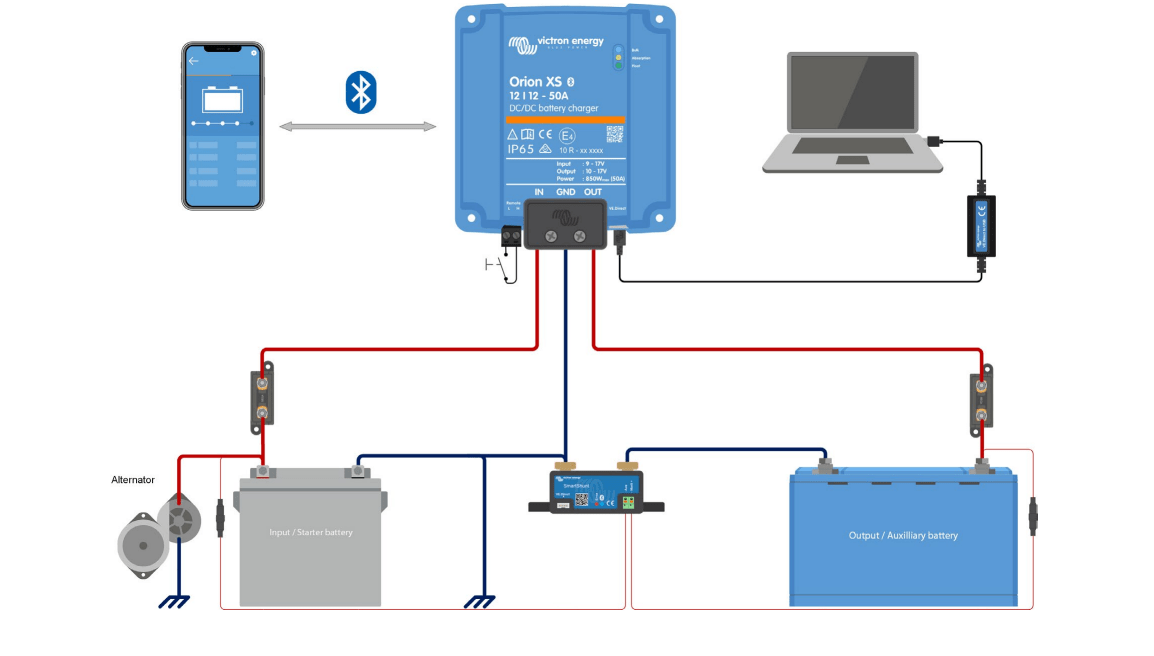
  • Orion XS emergency starter charge: The Orion XS adds an emergency charging function for the vehicle’s starter battery — a feature much sought after by the camper community.
  • New MultiPlus-II models (4,500W and 6,500W): They bridge the gap between existing 5,000VA models and high-power models.
  • SuperPack NG 12V 100Ah: Compact lithium battery with an integrated heating system for charging at sub-zero temperatures — ideal for installations in mountainous areas.
  • Victron Microgrids: Victron is developing microgrid capabilities for shared self-consumption amongst neighbours — a technology that Deye does not have in its public roadmap.

When does it make sense to choose Deye?

To be honest, there are use cases where Deye is the sensible choice:

  • A limited budget and simple self-consumption: If the aim is to reduce your energy bill with a basic on-grid system, without the need for off-grid solutions or advanced automation, and your budget is tight, Deye is a solid choice. The €1,300 saved on equipment can be spent on more panels and greater battery capacity.
  • Turnkey installation by a trusted fitter: If you have an installer who knows Deye well, has installed it many times and offers an installation guarantee, the simplicity of the all-in-one system (with integrated MPPT) makes commissioning a breeze.
  • Standard self-consumption scaling: For homes where the aim is simply to cover 60–70% of energy consumption with solar power and feed surplus energy back into the grid – without a backup system, load management or automation – Deye is the perfect solution.

When is it worth investing in Victron?

The price difference with Victron is justified when one or more of the following conditions are met:

  • You need critical reliability: Whether the system powers medical equipment, a home office with permanent remote working, a cold store or any other load that cannot fail, Victron has a 50-year track record of reliability in this field that Deye cannot yet match.
  • Off-grid installation (fully off-grid): The MultiPlus-II is specifically designed for off-grid use. Its battery management, PowerAssist and generator compatibility make the off-grid experience a world apart.
  • Do you want real automation: If you have, or are planning to install, an electric car charger, a heat pump, a swimming pool, a water heater or any other load that can be optimised using solar power, Victron’s Node-RED + Shelly will allow you to achieve a level of performance that Deye cannot offer.
  • Dynamic pricing: If you have, or are thinking of taking out, a tariff indexed to the PVPC or Tibber, Victron’s Dynamic ESS pays for itself in just 2–3 years thanks to its automatic optimisation of battery usage.
  • Are you planning to expand the system: If, in the future, you want to add more power, install a second inverter in parallel, or integrate new technologies, Victron’s open ecosystem offers greater scope for expansion.
  • Boating, campervans or mobile facilities: Victron dominates these sectors for very specific technical reasons: resistance to vibrations, compatibility with alternators, robustness in adverse environmental conditions, and the VictronConnect app, which is available without an internet connection.

Pricing and return on investment: the difference in perspective

The difference of around €1,300 between equivalent Deye and Victron systems represents, in a 5 kWp domestic installation with a 5 kWh battery:

  • The 15-20% of the total installation cost (including panels, framework and installation).
  • Approximately 18–24 months’ worth of savings on your bill additional amount you would need to generate to make up the difference.
  • Or to put it another way: with the €1,300 you’ve saved, you could buy approximately 2 additional 400W solar panels —which would generate more energy and permanently reduce the bill.

There is no one-size-fits-all answer. If Victron’s Dynamic ESS saves you an additional €200 a year with a dynamic tariff, you’ll recoup the difference in 6–7 years. If Victron’s reliability prevents a breakdown after 8 years, when a cheaper solution would already have failed, the calculation changes completely.

What we can say with certainty is: Victron has a lower failure rate in the field, a proven longer service life and a higher residual value if you decide to change the system.

Frequently Asked Questions: Deye vs Victron

Can I use a Pylontech battery with the Deye inverter?

On many Deye models, yes, via CANbus communication. However, the integration is not as comprehensive as with Victron: Victron’s DVCC allows the Pylontech BMS to directly control the inverter’s charge and discharge limits in real time, something that Deye handles in a more basic way. Always check specific firmware compatibility before combining systems.

Can Deye work without an internet connection?

The Deye inverter does work without an internet connection, yes. However, monitoring via SolarMAN requires a cloud connection to display data. Without an internet connection, you lose visibility of the system. The Victron Cerbo GX offers full local monitoring, independent of the internet.

Is Deye reliable? Does it break down a lot?

Deye has been on the Spanish market for several years and has a reasonable failure rate for its price range. The most frequently reported faults are with the WiFi board in the SolarMAN module and in some models featuring a proprietary lithium battery. After-sales support varies greatly depending on the distributor. Victron has a 50-year track record in the field with very low failure rates and more consistent technical support.

Will I be able to switch from Deye to Victron in the future?

Yes. The panels are fully reusable. The Deye BOS-G battery is not compatible with the Victron ecosystem, so it would need to be replaced. If you use Pylontech with Deye, that battery is compatible with Victron. The switch is technically possible — the cost depends on which battery you have.

Does FVComponentes.com sell Deye?

No. We are specialist Victron Energy distributors and do not stock Deye products. We have published this comparison because we believe that purchasing decisions should be based on comprehensive technical information, not just on price alone.

Are you unsure whether Victron or Deye is the best option for your specific installation? Tell us about your situation — power consumption, budget, type of installation — and we’ll give you an honest technical recommendation, with no obligation to buy.

Share this post:

Other blog entries

Pytes V5 vs Pylontech US5000: an honest comparison of 48V lithium batteries

The Pytes V5 and the Pylontech US5000 are the two most frequently compared 48V LiFePO4 lithium batteries on the Spanish market in 2026. They have been competing for the same customers for months: installers or private individuals looking for domestic solar storage integrated with a Victron system or similar. This comparison is based on real technical data and

Read more "

How to calculate and choose your Victron MPPT controller: a practical guide

The solar charge controller is the component I most frequently see being incorrectly sized in installations by customers who have bought parts separately. Choosing the wrong MPPT controller means losing solar output, damaging the battery or spending more than necessary. In this guide, I explain how to calculate exactly which solar charge controller you need. The difference between

Read more "