LiFePO4 battery: what it is, its advantages and which one to buy for solar power

LiFePO₄, LFP, lithium iron phosphate. Three ways of referring to the same technology, which in recent years has gone from being an expensive, specialised option to becoming the de facto standard for solar energy storage.

If you’re considering which battery to buy for your setup — whether it’s for a campervan, an off-grid home or a self-consumption system — this guide explains exactly what it is, why it has replaced lead-acid batteries, and which model is best suited to each situation.

What is a LiFePO4 battery?

LiFePO4 is the chemical abbreviation for lithium iron phosphate (Lithium Iron Phosphate), also known as LFP. It is a variant of lithium-ion technology in which the cathode material is iron phosphate rather than cobalt or manganese oxides (as in the NMC batteries used in electric cars).

This change in material has significant practical implications:

  • Cobalt-free: The supply chain is more stable and production costs have fallen dramatically over the last five years.
  • Superior chemical stability: Iron phosphate does not release oxygen when overheated, which virtually eliminates the risk of thermal runaway associated with NMCs. It is the safest lithium chemistry available.
  • Lower energy density than NMC, but sufficient for solar installations where weight and volume are not as critical as in an electric vehicle.

In short: a LiFePO4 battery is safer, longer-lasting and cheaper to maintain than any other lithium chemistry, which is why it has become the standard for solar storage.

Advantages of LiFePO4 compared to other batteries

The most significant comparison in the Spanish solar market is between LiFePO4 and AGM/gel (lead-acid) batteries. Here are the figures:

ParameterLiFePO4AGM / Gel
Service life cycles3.000 – 5.000500 – 800
Usable discharge depth80 – 100%50% max.
Actual energy per 100 Ah (rated)~80–100 Ah (actual)~50 Ah (actual)
Estimated useful life10–15 years3–5 years
Weight (same usable energy)~3 times lighter
Gases during chargingNoneYes (H₂ fast-charging)
MaintenanceZeroMinimum (AGM) / periodic (OPzS)

The practical conclusion: a 100 Ah LiFePO4 battery provides the same actual energy output as a 200 Ah AGM battery, with three times the service life. In a system used on a daily basis, this means that You won’t need to change the battery for the next 10–12 years.

Available voltages and capacities: which one do you need?

LiFePO4 solar batteries are manufactured in a range of nominal voltages. The choice depends on your system:

12V LiFePO4 batteries

The standard choice for campervans, motorhomes, boating and small off-grid installations. They are modular: you can connect them in parallel to increase capacity (same voltage, more Ah) or in series to achieve 24V or 48V.

Typical range: 50 Ah to 300 Ah per unit.

When to choose it: 12V inverter systems, mobility installations, daily energy consumption of less than 1,500 Wh.

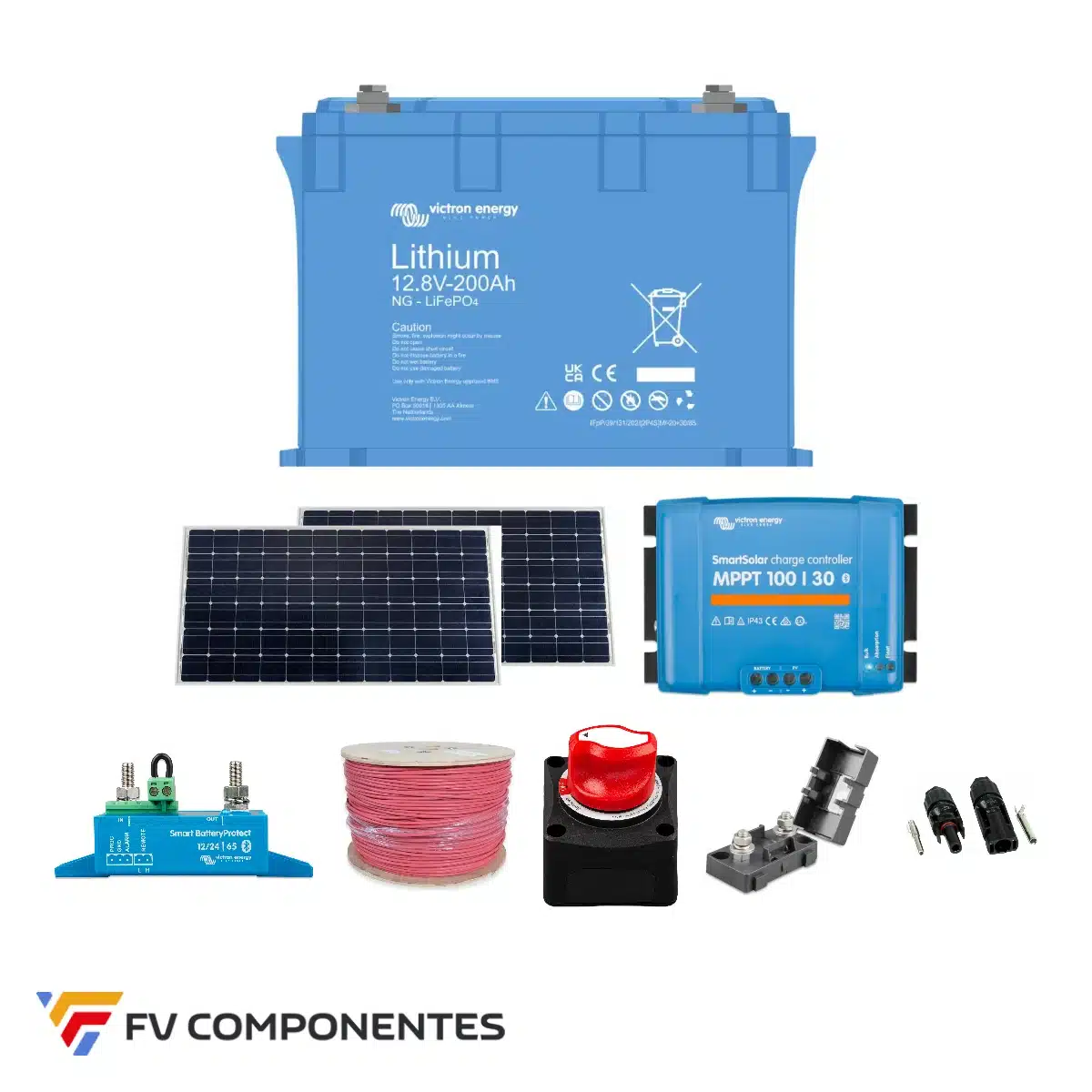
Recommended model: Victron LiFePO4 NG 12.8V — Native VE.Bus integration with Victron inverters and MPPT units.

48V LiFePO4 batteries

The current standard for domestic installations, whether off-grid or for self-consumption. At 48V, the current is a quarter of that at 12V for the same power output, which reduces resistive losses and allows the use of cables with a smaller cross-section.

48V systems are usually built using stackable modules: each module provides between 3.5 and 5 kWh, and the system can be easily expanded by adding modules to the stack.

When to choose it: homes, detached houses, light industrial facilities, any system fitted with a 48V Victron MultiPlus-II or Quattro inverter.

Recommended models: Pylontech US5000 y Pytes E-BOX-48100R — both with CANbus communication for DVCC on the Cerbo GX.

Which one to buy, depending on your setup

Let’s cut to the chase. These are the most common scenarios and the specific advice for each one:

SettingModelWhy
Camper van / minivanVictron LiFePO4 NG 12.8V 200AhNative VE.Bus integration, compact size, no additional configuration required with MPPT and MultiPlus 12V
Detached cottage / chalet (average energy consumption)2× Pytes E-BOX-48100R (9.6 kWh)Best kWh/€ ratio on the market with full DVCC support
Main residence (self-consumption + storage)3–4× Pylontech US5000 (10.5–14 kWh)The most tried and tested in Victron domestic systems, with a 10-year warranty
Expansion of the existing Victron systemThe same model you already have installedNever mix models or brands on the same bench
Critical backup (solar UPS)Victron LiFePO4 NG 25.6V + MultiPlusInstant response, seamless integration, minimal configuration

Does your situation not fit into any of these categories? Please contact us —based on your usage and the system you have, we’ll give you a specific recommendation.

What you need to check before buying

Three factors that make the difference between a battery that works well for 12 years and one that starts playing up in its second year:

1. BMS with standard communication

The battery must have an integrated BMS with a communication protocol compatible with your inverter. For Victron systems: VE.Bus (Victron NG batteries) or CANbus (Pylontech, Pytes). Without active communication between the BMS and the inverter, the system cannot apply DVCC and the battery operates without dynamic load protection.

2. Manufacturer’s warranty

Reputable manufacturers guarantee a minimum capacity retention of 80% at the end of the warranty period. Victron, Pylontech and Pytes offer a 10-year warranty. Be wary of brands that guarantee cycle life but not residual capacity.

3. Certified compatibility with your inverter

It is not enough for it simply to «be LiFePO4». Victron publishes an official list of DVCC-compatible batteries in its documentation. Before purchasing, check that the model is on that list or consult a specialist dealer.

Frequently asked questions

Are LiFePO4 and LFP the same thing?

Yes. LFP is the abbreviated form of LiFePO₄ (lithium iron phosphate). They are the same type of battery.

Can I charge a LiFePO4 battery with a lead-acid charger?

Technically, it may work if the charger allows you to manually set the absorption voltage (14.2V for 12V), but this is not recommended. Lead-acid chargers use charging curves (IUoU) designed for lead-acid batteries. A lithium-compatible charger or a correctly configured Victron inverter/charger will significantly extend the battery’s service life.

At what temperature does a LiFePO4 battery stop working?

Discharging is possible between -20°C and +60°C. Charging is limited to 0°C – +45°C. Below 0°C, the BMS blocks charging to prevent damage to the cells. For outdoor installations or in cold climates, consider insulating the battery compartment.

Is it safe to install LiFePO4 batteries in an enclosed space?

Yes. Unlike lead-acid batteries (which emit hydrogen during charging), LiFePO4 batteries do not produce gases under normal operating conditions. They can be installed in cupboards, enclosed rooms or van compartments without the need for special ventilation.

How long does it take to charge a LiFePO4 battery?

It depends on the capacity of the charger/inverter and the battery’s Ah rating. A 200 Ah battery with a 50 A charger takes around 4 hours to go from 20% to 100%. LiFePO4 batteries can handle charging rates of up to 1C (100A for a 100 Ah battery) without damage, making them considerably quicker to charge than lead-acid batteries.

If you’re comparing models or need to check that the battery you’ve chosen is compatible with your Victron system, our technical team can advise you before you buy.

Share this post:

Other blog entries

Pytes V5 vs Pylontech US5000: an honest comparison of 48V lithium batteries

The Pytes V5 and the Pylontech US5000 are the two most frequently compared 48V LiFePO4 lithium batteries on the Spanish market in 2026. They have been competing for the same customers for months: installers or private individuals looking for domestic solar storage integrated with a Victron system or similar. This comparison is based on real technical data and

Read more "

How to calculate and choose your Victron MPPT controller: a practical guide

The solar charge controller is the component I most frequently see being incorrectly sized in installations by customers who have bought parts separately. Choosing the wrong MPPT controller means losing solar output, damaging the battery or spending more than necessary. In this guide, I explain how to calculate exactly which solar charge controller you need. The difference between

Read more "