Solar panel batteries: types, how to choose and which one to buy in 2026

A solar panel battery isn’t just any old battery, and choosing the wrong one can cost you dearly — literally. The difference between a lead-acid battery that needs replacing after four years and a LiFePO4 battery that lasts 15 years with twice the usable capacity translates into a difference of hundreds of euros in the total cost of your installation.

In this guide, I explain the different types available, how to work out exactly what you need, and which models I recommend depending on the type of installation, with a particular focus on compatibility with Victron inverters — a factor that hardly anyone mentions and which makes all the difference between an installation that works well and one that causes problems.

What is the purpose of a battery in a solar installation?

Solar panels generate energy when the sun is shining. The problem is that consumption doesn’t always match production: midday is when the panels generate the most energy, but it’s also when you use the least if you’re out of the house.

The battery bridges that gap: it stores surplus energy during the day and releases it when you need it — at night, on cloudy days or during power cuts.

Here is the important distinction:

  • Off-grid installation: A battery is essential. Without it, you have no power when the sun isn’t shining. This is the case for holiday cottages, country houses, campervans or any property without access to the mains electricity supply.
  • Grid-connected self-consumption system: The battery is optional. Without it, surplus energy is fed back into the grid at the buy-back price (which is very low, at around €0.05–0.08/kWh). With a battery, you can use that energy yourself, which significantly improves the return on investment.

Types of batteries for solar panels

Not all solar batteries are the same, either in terms of technology or their long-term cost. These are the four main types.

LiFePO4 lithium batteries

They are the recommended choice for any new installation worth its salt. Lithium iron phosphate (LiFePO₄) chemistry offers performance that no other technology in this segment can match:

  • 3,000 to 5,000 charge cycles the discharge rate of the 80% — compared with 500–800 for a conventional AGM battery.
  • Download up to 80-100% without structural damage. In lead-acid batteries, exceeding the 50% discharge limit drastically shortens the service life.
  • High energy density: For the same volume and weight, they store considerably more usable energy.
  • Maintenance-free and produce no gases during charging — they can be installed indoors.
  • Native communication with Victron via the DVCC protocol: the battery’s BMS directly manages the inverter’s load, maximising efficiency and protection.

The initial cost is higher than that of lead-acid batteries, but the total cost of ownership (TCO) over 10 years is considerably lower. If you are installing a new system or replacing a battery bank, there is no point in choosing any other technology.

Recommended for: camper vans, new off-grid installations, self-consumption with storage, Victron systems.

AGM batteries

Lead-acid technology with the electrolyte absorbed into a fibreglass mat (Absorbent Glass Mat). Sealed and maintenance-free, they represent the next generation of traditional liquid-lead batteries.

Its advantages: low entry-level price, universal compatibility with any MPPT controller or charger, and good tolerance to occasional discharges provided it is not overused.

Their limitations: 500–800 actual discharge cycles for the 50%, which is equivalent to 3–5 years of normal use in a domestic installation. They are quite heavy and take up more space than lithium batteries for the same amount of usable energy.

They are suitable for: very tight budgets, installations used only occasionally (second homes with low energy consumption), replacement of an existing battery in an installation that has already been written off.

Gel batteries

These are also lead-acid batteries, but with a gelled electrolyte. They offer greater tolerance to high temperatures than AGM batteries and lower self-discharge, making them somewhat more suitable for hot climates or installations that remain unused for months at a time.

The cycle life is similar to or slightly longer than that of AGM batteries (600–900 cycles, depending on the manufacturer), but is still considerably shorter than that of lithium batteries.

They are suitable for: installations in hot environments, backup systems (UPS) with long periods of inactivity.

OPzS/OPzV stationary batteries

They are the industry standard for large-scale installations: telecommunications, hospital backup systems, and megawatt-scale photovoltaic installations.

Exceptional lifespan (15–20 years with proper maintenance), but they require a ventilated battery room, regular maintenance, and a budget and space that are beyond the reach of domestic installations.

This is not a standard FVC product. If your project requires this type of battery, contact us to assess it.

How to work out the capacity you need

This is the step that most people skip and where the most mistakes are made. It shouldn’t be too small (you’ll run out of power in the middle of the night) or too large (you’ll be paying for capacity you don’t use).

The basic formula:

Capacity (Ah) = Daily consumption (Wh) × Number of days of autonomy ÷ System voltage (V) ÷ Depth of discharge

Practical example: A cabin with an estimated consumption of 2,000 Wh/day, a 24V system, a lithium battery (discharged to 80%) and a 2-day runtime without sunlight:

2,000 Wh × 2 days ÷ 24 V ÷ 0.80 = 208 Ah

Conclusion: a 200–250 Ah 24V battery pack is sufficient.

UseEstimated consumptionTensionOrientation skills
Camper van / minivan500–1,000 Wh/day12V100–200 Ah lithium
Cottage / small chalet1,500 – 3,500 Wh/day24V150–300 Ah lithium
Detached main residence4,000 – 10,000 Wh/day48V200 Ah lithium in modules
Self-consumption + storageVariable48VBased on surplus solar energy

Victron tip: With the Cerbo GX + Venus OS, you can monitor the actual status of the battery bank, view historical charge and discharge patterns, and adjust the strategy remotely. This allows you to start with a conservative capacity and scale up if necessary.

Inverter compatibility: the factor that hardly anyone mentions

This is the key difference between a setup that works well and one that causes problems — and it’s something virtually no online shop will tell you about.

A LiFePO4 battery of any make It’s not always plug-and-play with a Victron inverter/charger. The reason is the protocol DVCC (Distributed Voltage and Current Control).

What is the DVCC and why is it important?

With DVCC enabled on the Cerbo GX, the battery’s BMS communicates with the MultiPlus or Quattro and tells it exactly how much current it can accept at any given time, what the maximum charging voltage is, and when it should stop. The inverter follows these instructions in real time.

The result: the battery is never overcharged, never undercharged, and its service life is maximised. This is the correct way to integrate a lithium battery into a Victron system.

DVCC-compatible batteries in Victron systems

  • Victron LiFePO4 NG: Native VE.Bus communication. No adaptors, no complex configuration. The cleanest possible integration.
  • Pylontech (US2000, US3000, US5000) and Pytes: CANbus communication with Cerbo GX. Fully supported and tested.
  • BYD B-Box: Compatible via VE.Can.
  • Batteries without a communication-enabled BMS: They work, but without DVCC the inverter uses its own settings. This requires careful manual configuration.

Recommended models by type of installation

InstallationModelEnergyTension
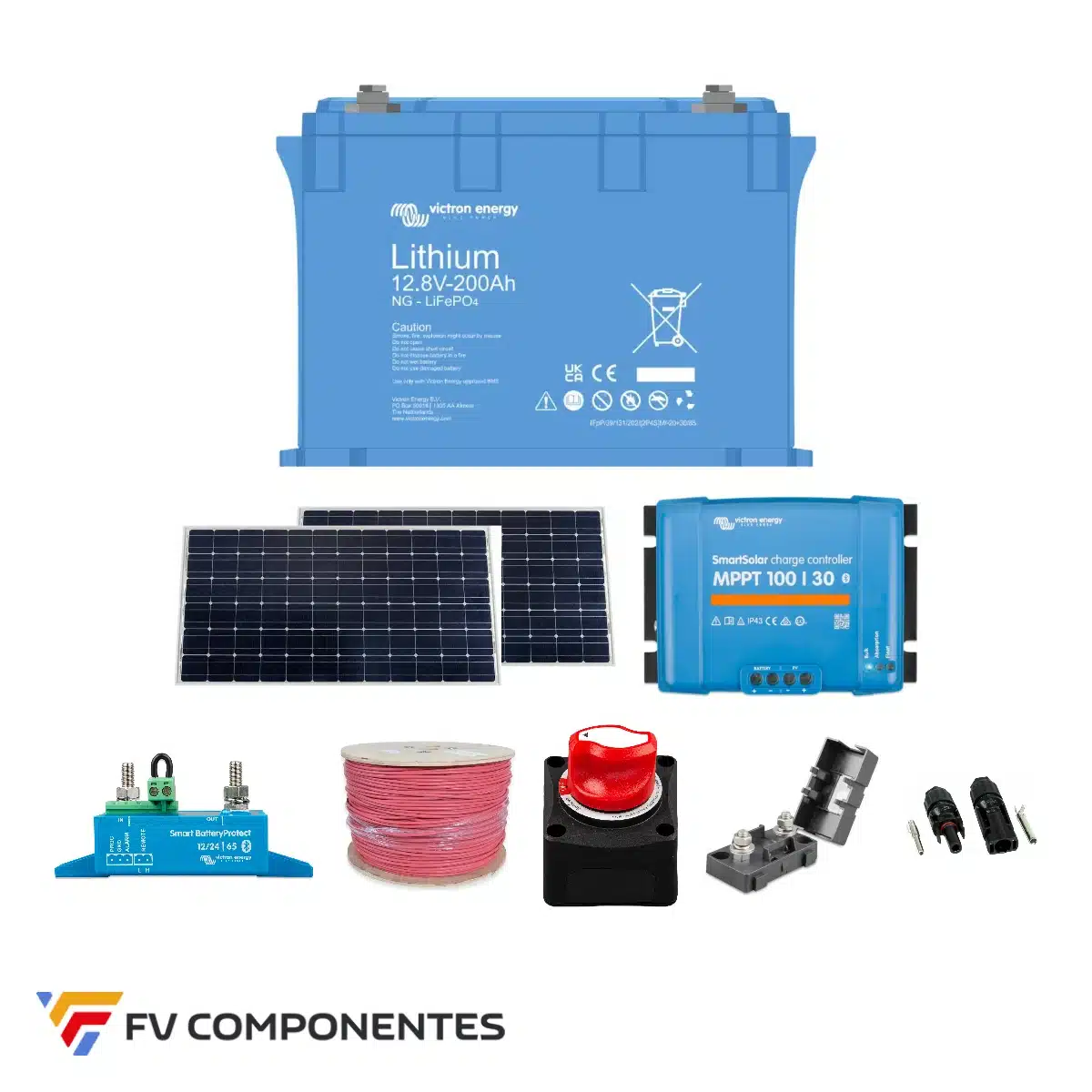
Camper van / minivanVictron LiFePO4 NG 12.8V 200Ah2,560 Wh12V
Secluded cottage / chaletPytes E-BOX-48100R4,800 Wh48V
Victron system upgradePylontech US50004,800 Wh48V
Detached house (high energy consumption)Contact us about a projectModular48V

For installations with a storage capacity exceeding 10 kWh or those combining several modules, it is advisable to carry out a full technical assessment.

Frequently asked questions

Which type of battery is best for solar panels – AGM or lithium?

LiFePO4 lithium batteries in virtually all new installations: longer service life (3,000–5,000 cycles compared to 500–800 for AGM batteries), greater usable depth of discharge and lower total cost of ownership over the lifetime of the installation. AGM batteries only make sense on a very tight budget or in installations with very sporadic use and low energy consumption.

How many Ah do I need for a solar installation?

It depends on your daily consumption, the number of days’ autonomy you want to have without sunlight, and the system voltage. For a domestic installation with moderate consumption (2,000 Wh/day), a 24V system and 2 days’ autonomy with lithium batteries, you’ll need around 200–250 Ah. Use the formula: Ah = Wh/day × days ÷ volts ÷ depth of discharge.

Is any LiFePO4 battery compatible with a Victron inverter?

Functionally, yes, but not all of them make use of Victron’s DVCC protocol. The Victron LiFePO4 NG, Pylontech and Pytes are officially supported and communicate with the Cerbo GX via CANbus or VE.Bus, which is the correct way to integrate them into a Victron system.

Can I connect batteries in parallel to increase their capacity?

With LiFePO4, it depends on the model. Victron LiFePO4 NG batteries support up to 5 in parallel. Pylontech and Pytes batteries can be stacked. Never mix batteries of different brands, different capacities or with different states of charge.

What is the difference between a 12V, 24V and 48V solar battery?

This is the nominal voltage of the battery bank. 48V systems are the most efficient: the higher the voltage, the lower the current required for the same power output, which reduces losses and allows for thinner cables. 12V is standard in motorhomes and boats. 48V is the current standard in Victron domestic installations.

Are you unsure which battery is suitable for your system or your Victron inverter? Ask our technical team — we’ll give you a genuine technical answer, with no sales pressure.

Share this post:

Other blog entries

Pytes V5 vs Pylontech US5000: an honest comparison of 48V lithium batteries

The Pytes V5 and the Pylontech US5000 are the two most frequently compared 48V LiFePO4 lithium batteries on the Spanish market in 2026. They have been competing for the same customers for months: installers or private individuals looking for domestic solar storage integrated with a Victron system or similar. This comparison is based on real technical data and

Read more "

How to calculate and choose your Victron MPPT controller: a practical guide

The solar charge controller is the component I most frequently see being incorrectly sized in installations by customers who have bought parts separately. Choosing the wrong MPPT controller means losing solar output, damaging the battery or spending more than necessary. In this guide, I explain how to calculate exactly which solar charge controller you need. The difference between

Read more "