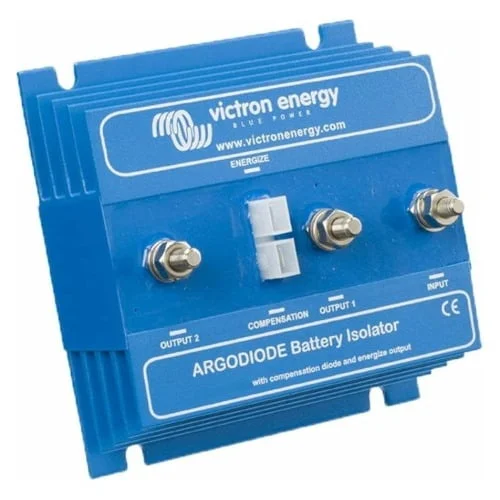
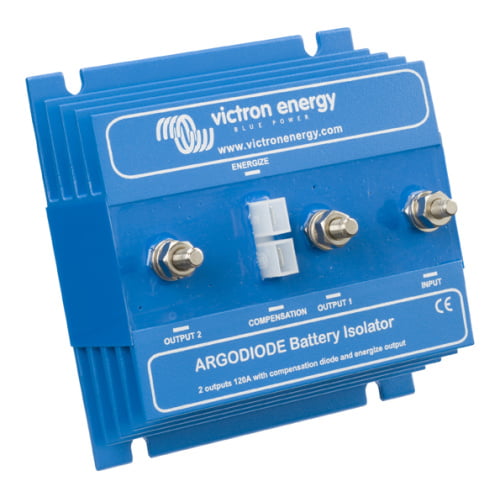
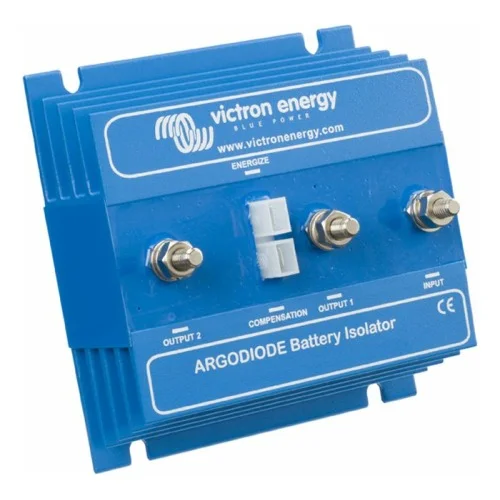
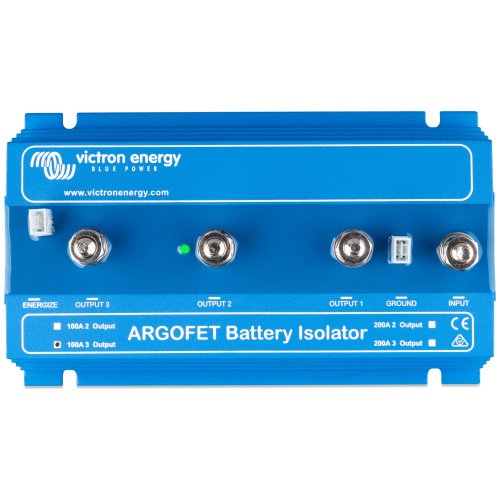
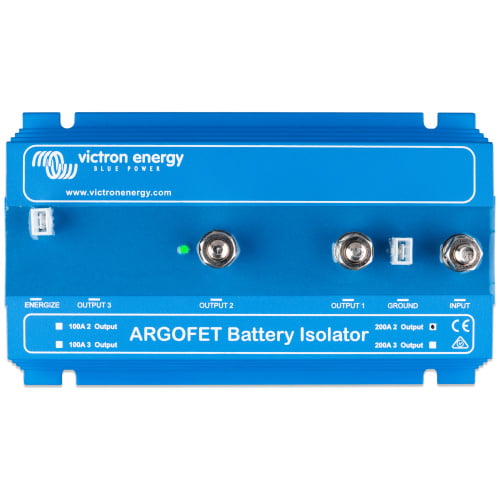
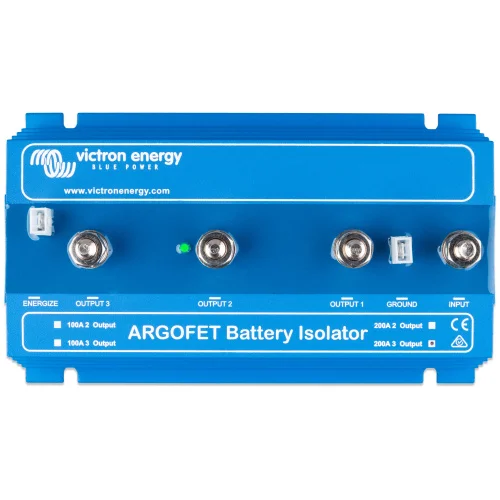
A diode separator allows two or more battery banks to be charged from a single alternator or charger, without them discharging one another. It is the standard solution when the charge needs to be shared between the starter battery and one or more auxiliary batteries, which is very common in boating and in vehicles with complex electrical systems.

How a diode bridge works for charging batteries

The diode allows current to flow in one direction only. When connected between the alternator and each bank, it allows the charge to reach all the batteries but prevents energy from flowing back from the fully charged bank to the empty one. Each battery is thus isolated from the others, and none can drain another.
The downside is the voltage drop: a conventional diode consumes between 0.6 and 1 V, and this loss means that the batteries never fully charge. That is why high-quality isolators use Schottky diodes, which have a voltage drop of around 0.3 V, and why it is advisable to compensate for this difference in the alternator regulator where the equipment allows.

Diode, relay or DC-DC converter

  • Diode separator: The best option when there are three or more batteries to charge simultaneously, all of which are lead-acid, AGM or gel. No moving parts and maintenance-free.
  • Isolating relay: It’s simpler and there’s no voltage drop, but it connects the battery banks in parallel whilst charging, so they must use the same technology.
  • DC-DC converter: mandatory if any of the batteries are lithium, and also in vehicles with smart alternators, where neither the diode nor the relay operates correctly because the alternator voltage is variable by design.

How to work out the correct size

Based on the alternator’s maximum current, allowing for a margin. For a 120 A alternator, a 120–160 A rectifier. Bear in mind that diodes generate heat: they require a heat sink and a well-ventilated location; never install them inside an enclosed cabinet.
Install it near the charging point, with fuse at each outlet, and a cable of sufficient cross-section, which you can calculate in the Cross-section table by power rating.
Tell us how many banks you need to charge and what technology they use, and we’ll tell you whether a diode, relay or booster is best for you: free consultation.